
Group Relationship Coaching: Reimagining Love Through Collective Healing
What is Group Relationship Coaching? A Space for Reimagining Connection
To feel misunderstood in your deepest relationships is a profoundly isolating experience. It's a quiet ache, a story you believe is yours alone. Group relationship coaching is a deliberate, psychologically-informed space designed to dismantle that isolation. It is not a peer-led support group, but a structured container for collective growth, guided by an expert facilitator. Here, the journey shifts from the solitary 'me' trying to fix a problem to the collective 'we' discovering a new way of being.
The entire atmosphere is built around a core understanding: our experience of love and heartbreak is created from the inside-out. The group becomes a living laboratory for witnessing this principle in action, a place where individual breakthroughs are amplified and normalised through shared human experience.
The Core Pillars of a Coaching Container
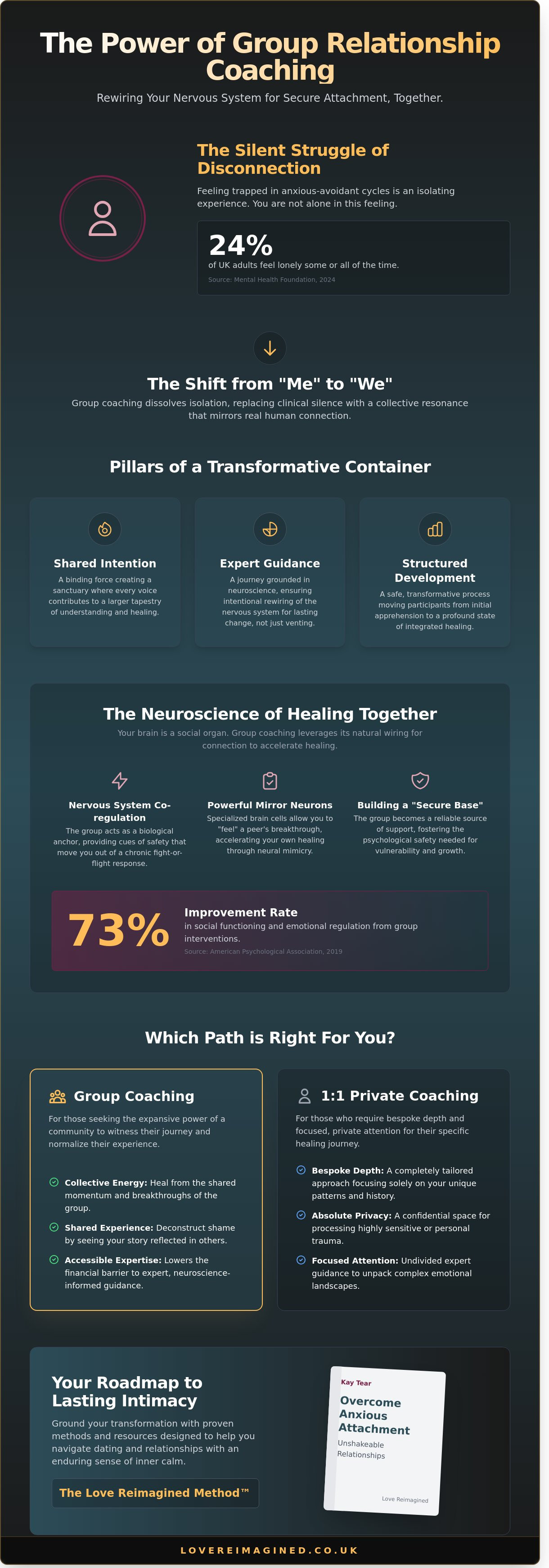
Shared Intention: A group united by a common goal—to move from anxious patterns to secure, intentional connection—creates a powerful current of momentum. This shared 'why' accelerates the healing process for everyone involved.
Expert Guidance: The journey is navigated with a neuroscience-informed perspective. A coach trained in understanding the human mind, like Business Psychologist Kay Tear, facilitates the process of making thinking visible, moving beyond surface-level advice to address the root of your internal script.
Structured Evolution: The experience is not a series of disconnected conversations. It is a curated path, moving participants through distinct stages of awareness, understanding, and finally, the integration of profound core shifts into their daily lives.
Reimagining the ‘Private’ Struggle
The shame that often accompanies anxious attachment or the fallout from a painful breakup thrives in silence. It convinces you that your thoughts, your fears, and your patterns are uniquely flawed. Group relationship coaching directly challenges this narrative.
By seeing your own internal script reflected in the stories of others, the deeply held belief that you are 'the only one' begins to dissolve. This is where the atmospheric shift happens. We move away from the frantic energy of 'fixing' a broken part of ourselves and into the calmer, more profound work of documenting a legacy of growth, together.
The Neuroscience of the Group: Why We Heal Better Together
Healing our attachment patterns is not simply an intellectual exercise; it is a biological one. It requires rewriting the deeply ingrained neural pathways that keep us in cycles of anxiety and fear. While this work can be done alone, the human brain is fundamentally social. It is wired to heal in connection with others, and a group coaching container provides the optimal environment for this rewiring to occur.
This process is rooted in the concept of co-regulation: the biological bridge to emotional self-leadership. Our nervous systems are designed to attune to those around us. When we enter a space with others who are intentionally cultivating calm and safety, our own nervous system responds, learning that it can down-regulate from a state of fight-or-flight. This is the social proof our brain needs to believe that safety is not only possible, but sustainable.
Nervous System Regulation in a Collective Space
In attachment theory, a 'secure base' is a person who provides a sense of safety from which we can explore the world. A well-facilitated group can become a collective secure base. It acts as a resilient container, capable of holding the intense emotions of grief, longing, or fear without breaking. This allows you to feel and process these emotions fully, rather than suppressing them or being overwhelmed by them, which is a crucial step towards achieving genuine emotional grounding.
Rewiring Attachment Through Witnessing
As Kay Tear explains in her book, Overcome Anxious Attachment, much of our suffering comes from the meaning we assign to our experiences through our thinking. In a group, we witness this process unfold in real-time.
When you share a vulnerable thought and are met with understanding instead of judgement, your brain receives powerful new data. Mirror neurons fire, allowing you to feel the empathy of the group and see your own experience validated. This low-stakes 'laboratory' for connection allows you to experiment with new behaviours and ways of thinking, slowly dismantling fear-based patterns and building the foundations for secure, authentic relationships.
Group vs. Private Coaching: Which Path Should You Choose?
The decision between group and one-on-one coaching is not about which is 'better,' but which is the most resonant and effective path for you at this moment. It requires an honest evaluation of your current emotional capacity and what you most need to create a foundational core shift in your life. The unique benefit of 1:1 coaching lies in its deep, bespoke nature for unpacking complex personal histories, while group coaching excels at social integration and dismantling the illusion of isolation.
When to Opt for 1:1 Private Coaching
You are navigating acute heartbreak or trauma that requires immediate, intensive grounding and support to move through the day.
The thought of sharing in a group feels overwhelmingly dysregulating right now, and you need a completely private sanctuary to begin making your thinking visible.
Your internal script is deeply entangled with specific, complex family-of-origin wounds that require dedicated, individualised attention to unravel.
When Group Relationship Coaching is the Superior Choice
You feel 'stuck' in your own head, endlessly replaying the same thought loops, and suspect that outside perspectives will help you see your patterns more clearly.
You struggle with social anxiety, a fear of being 'too much,' or a pattern of withdrawing when you feel insecure. The group provides a safe space to challenge these beliefs.
You are seeking a more sustainable, long-term rhythm for your growth, supported by the accountability and shared wisdom of a community.
If you're unsure which path best suits you, a great first step is understanding your current baseline. Take our free quiz to assess your emotional grounding and relationship goals.
What to Expect: Navigating the Group Coaching Experience
Stepping into a group coaching container for the first time can feel like a courageous act. The experience is intentionally designed to honour that courage by creating a sanctuary of psychological safety from the very first moment. The focus is always on creating an atmosphere that is both unfiltered and deeply respectful, allowing for profound honesty without fear of judgement.
A typical session begins with an emotional grounding exercise, guiding the group out of the busyness of the day and into a state of present-moment awareness. From there, the session unfolds into a blend of teaching, guided reflection, and deep-dive coaching on the challenges and breakthroughs members are experiencing. Confidentiality is paramount, with clear agreements organised and protected to ensure the container remains a trusted space for vulnerability.
Creating a Sanctuary of Safety
The power of the group lies in its shared commitment to the rules of engagement. These are not rigid restrictions, but conscious agreements to listen with presence, speak from personal experience, and honour the privacy of every story shared. The coach's role is to manage the ebb and flow of the group's energy, ensuring that every member feels seen and protected. Overcoming the initial fear of sharing is a key part of the process, as you quickly learn that the focus is less on the specific details of your story and more on the universal human thinking that drives it.
Tools for Emotional Self-Leadership
This is not a space for passive listening; it is an active training ground for emotional self-leadership. You will learn practical, neuroscience-informed exercises to regulate your nervous system, both during our sessions and in your real-world interactions. The goal is to integrate the lessons from the group into your daily life, making core shifts that last. We focus on the 'why' behind your feelings, moving beyond simply 'managing triggers' to fundamentally understanding how your internal experience is created. This empowers you to build what we explore in articles on topics like the psychology and neuroscience of choosing to stay in a relationship.
From Anxious to Anchored: The Love Reimagined Approach
The Love Reimagined philosophy, which forms the foundation of the From Anxious to Anchored™ programme, is woven into every aspect of our group coaching. It is an approach grounded in the profound yet simple understanding that our entire experience of life is created from the inside-out, through the power of our own thinking. We move away from giving 'advice' or analysing external circumstances, and instead, guide you back to the source of your own wisdom.
This work is about moving from a life of anxious reactivity to one of inner peace and deep, unshakeable confidence. It is about understanding that 'fear isn't truth' and learning to distinguish the feeling of emotional intensity from true intimacy. This is the path to becoming securely anchored within yourself, no matter who you are or are not in a relationship with.
The From Anxious to Anchored™ Experience
This signature programme is a structured journey designed to help you make your internal script visible, understand its origins, and consciously rewrite it for a future of secure connection. The soulful, storytelling approach of the group allows you to see your own patterns with more compassion and clarity. You are ready for this collective journey if you are tired of the exhausting cycle of anxiety and avoidance and are willing to look inward for the source of lasting change.
Taking the First Step Toward Security
True transformation begins the moment you realise that the key to a different future is not in changing others, but in understanding the nature of your own mind. Choosing a coach and a community that understands the 'why' behind your patterns is the most important first step. We invite you to embrace the beautiful, imperfect, and profoundly human process of healing in a shared space.
When you are ready to stop the spiral of anxious thoughts and begin building a foundation of inner security, we are here to show you the way.
Download our free guide to stop the spiral and find your calm.
Frequently Asked Questions
Is group relationship coaching as effective as one-on-one sessions? Effectiveness depends on your goals. For creating deep core shifts around social connection, normalising your experience, and learning through shared insight, group coaching can be even more effective than 1:1 work. It provides a real-time environment to see psychological principles in action across different people, which accelerates your own understanding.
What if I'm too anxious to speak up in a group setting? This is a very common and understandable fear. A well-facilitated group is designed to be a safe space where there is no pressure to share until you feel ready. Often, members find that simply listening and witnessing others' stories is profoundly healing. The act of being present in a supportive environment is a powerful step in itself.
How is group coaching different from a support group or therapy? While all can be supportive, their structure and focus differ. Support groups are often peer-led and focus on shared commiseration. Therapy, led by a licensed clinician, is designed to diagnose and treat mental health conditions. Group coaching, led by a professional coach, is forward-focused. It uses psychological principles to help functional individuals close the gap between where they are and where they want to be, focusing on building skills for emotional self-leadership.
Can I join a group if I'm currently going through a traumatic heartbreak? This depends on the intensity of your experience. If your trauma is acute and you are struggling with daily functioning, intensive 1:1 support is often a better starting point. However, if you have some stability but are struggling with the lingering pain and thought patterns of heartbreak, a group can be an incredibly powerful container for healing and perspective.
How many people are usually in a relationship coaching group? To maintain an atmosphere of intimacy and ensure everyone has the opportunity to be seen and heard, our groups are intentionally kept small, typically with no more than 8-10 members.
Is my privacy protected when sharing personal details in a group? Absolutely. Confidentiality is the foundational rule of any coaching group. All members sign a clear agreement before the programme begins, committing to keep everything shared within the container completely private. This creates the trust necessary for true vulnerability and growth.