Commitment Reimagined: The Psychology and Neuroscience of Choosing to Stay
Commitment. The word itself can feel both like a warm, safe harbour and a terrifying, final choice. For so many of us, particularly those who have known the sharp edges of heartbreak, it feels at once essential and impossible. We crave the security it promises but fear the loss of self it seems to demand. This is the paradox that keeps us in cycles of anxiety—yearning for a deep, unfiltered connection while our nervous system screams for an exit.
But what if we reimagined commitment not as a destination or a contract, but as a rhythmic, intentional practice? What if it’s not about finding the ‘perfect’ person, but about cultivating the emotional self-leadership to choose a shared legacy, day after day? This is not about performing for love, but about creating the psychological safety to finally, trulybein love.
Defining Commitment: Beyond the Traditional Script
In its most authentic form, commitment is the intentional choice to prioritise a shared future over momentary emotional fluctuations. It’s the quiet, steady decision to stay and tend to the garden, even on the grey days when the sun isn’t shining. It’s an act of profound courage.
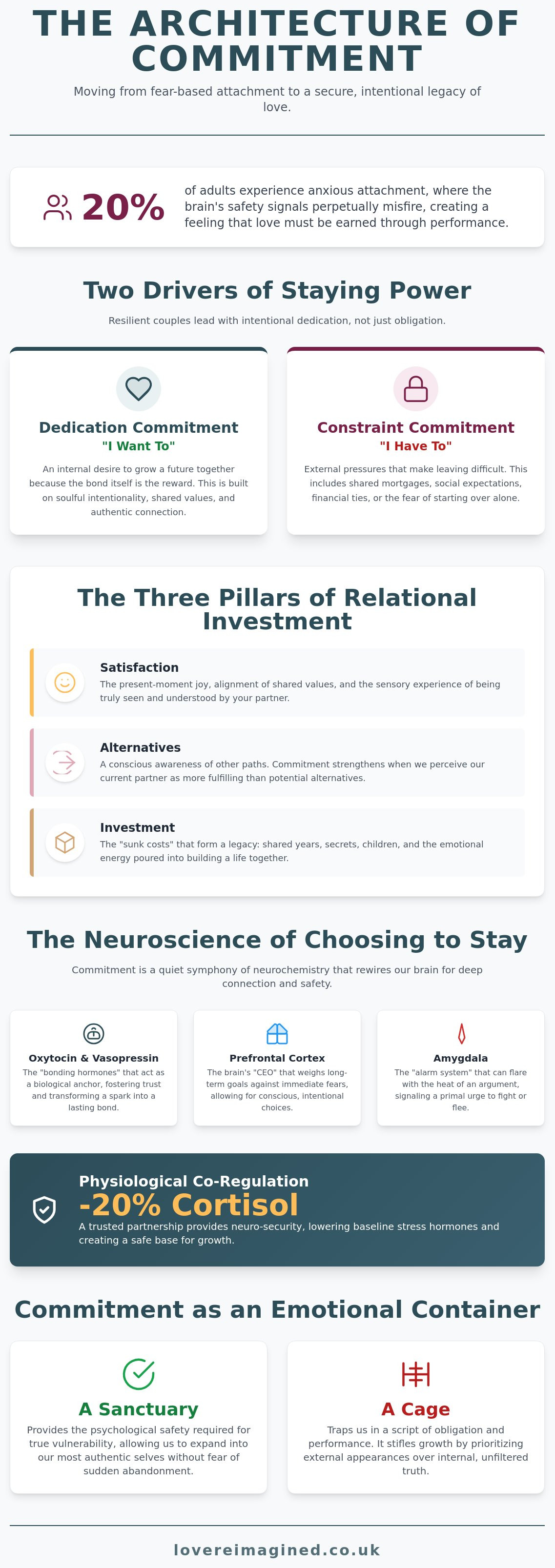
Modern relationship science distinguishes between two very different forms of commitment. Constraint commitment keeps people together because leaving feels difficult — shared finances, social pressure, children, or the fear of starting over. Dedication commitment, on the other hand, is the internal, freely chosen desire to build a future with someone.
Research consistently shows that while both forms can maintain a relationship, dedication commitment is strongly associated with higher satisfaction, lower conflict, and greater long‑term stability. In fact, a study published in Marriage & Family Review found that dedication was a significantly stronger predictor of relationship stability and life satisfaction than constraint commitment.
This is the shift we are interested in: moving away from a performative tradition and towards an unfiltered, authentic connection. It’s about choosing your person not because you have to, but because your life is more expansive with them in it.
The Three Pillars of Relational Investment
To understand this deep psychological investment, we can look to the Investment Model, which breaks down our choice to stay into three core pillars:
Satisfaction:This is the baseline of joy. It’s the pleasure, fulfilment, and shared values you experience in the present moment. It’s the laughter over dinner, the easy silence, the feeling of being truly seen.
Alternatives:This is a conscious or unconscious assessment of your other options. When commitment is strong, the allure of alternatives fades. You choose this person not because there is no one else, but because, among a world of options, this connection feels the most like home.
Investment:These are the ‘sunk costs’—the tangible and intangible resources that become woven into the fabric of your shared life. It’s the memories, the inside jokes, the challenges you’ve overcome together. This is the legacy you are co-creating, which becomes more precious over time.
Commitment as an Emotional Container
Ultimately, commitment creates the safety required for true vulnerability and expansion. It transforms a relationship from a fragile arrangement that could break at any moment into a sanctuary—a secure container where both partners can grow. It’s the difference between a cage that restricts you and a home that grounds you.
Commitment is the psychological ‘secure base’ from which we can explore the world, knowing we have a safe harbour to return to.
The Neuroscience of Choosing: How Your Brain Processes Commitment
Your decision to commit is not just a romantic notion; it’s a complex biological process. The brain is wired for connection, using a cocktail of neurochemicals to foster the long-term bonds that define our lives.
The Bonding Hormones: Oxytocin and vasopressin are crucial in creating feelings of trust, empathy, and attachment, forming the neurochemical bedrock of a long-term pair bond.
The Executive Thinker:When your amygdala (the brain’s fear centre) sounds the alarm over the vulnerability of intimacy, it is your prefrontal cortex that mediates the response. This is the part of your brain responsible for long-term planning and emotional regulation; it allows you to make the conscious ‘choice’ to stay, even when old fears surface.
Attachment & The Brain: Your early attachment experiences shape how your brain perceives a partner’s behaviour. For someone with a secure attachment style, a partner’s need for space is seen as normal. For someone with an anxious attachment style, it can trigger a primal fear of abandonment. For example, research indicates that as many as 20% of adults exhibit high levels of attachment anxiety, which can make the perceived risks of commitment feel overwhelming.
Neuroplasticity: The most hopeful news from neuroscience is that our brains can change. Through intentional practices and new relational experiences, we can rewire our neural pathways to feel safer in committed, loving containers.
The Nervous System at Rest: Commitment as Safety
A truly committed relationship is a masterclass in co-regulation. When you feel safe with a partner, their calm presence can soothe your physiological stress responses. This is the ‘Proximity Effect’—the simple act of being physically and emotionally present with a trusted other can lower cortisol and regulate your heart rate. When this neuro-security is absent, our bodies register it as a threat, activating a fight-or-flight response that can mimic a lack of commitment, even when that isn’t the reality.
Attachment Wounds and the Commitment Gap
Our past often dictates our present capacity for commitment. This is where our ‘internal script’ can cause us to mistake intensity for intimacy.
The Anxious Brain: For those with an anxious attachment style, the brain is hyper-vigilant for signs of abandonment. A small shift in a partner's attention or a slightly different tone can feel like a catastrophic breach of commitment, triggering a spiral of protest behaviour.
The Avoidant Brain: For those with an avoidant attachment style, deep intimacy can feel suffocating. They employ ‘deactivating strategies’—like focusing on a partner’s flaws or creating emotional distance—to create a false sense of independence and safety.
This painful cycle of ‘pursuit and withdrawal’ is a hallmark of attachment insecurity. The first step to breaking it is developing a deep awareness of your own nervous system and learning to see your thinking for what it is—a protective pattern, not an undeniable truth.
The Shadow Side: Why We Fear the Very Thing We Crave
The number one objection I hear in my work as a Human Experience Specialist is the fear that commitment means a loss of self—that it’s a cage where autonomy and adventure go to die. But is the fear truly about the other person, or is it about the overwhelming feelings that deep connection brings to the surface?
Often, what we label ‘commitment phobia’ is actually a profound fear of being seen. It’s the terror of someone getting close enough to see our imperfections, our legacy wounds from past heartbreak, and the parts of ourselves we believe are unlovable. We fall into the ‘perfectionism trap,’ waiting for a flawless partner or for ourselves to be ‘healed’ before we can dare to commit, not realising that healing happens within the safety of a secure connection, not just before it.
Misconceptions vs. Reality in Long-Term Love
Myth: Commitment should feel easy and effortless every single day.
Reality: Intentional love requires choosing your partner even on the ‘grey’ days. It’s about navigating challenges together, not pretending they don’t exist.
Myth: If I’m truly in love, I won’t be attracted to anyone else.
Reality: The ‘Grass is Greener’ syndrome is a powerful illusion, fuelled by the dopamine hit of novelty. True commitment is choosing the depth of the known over the fantasy of the new. A 2018 study published in theArchives of Sexual Behaviorfound that 42% of Tinder users were already in a relationship, highlighting the powerful allure of perceived alternatives in our modern dating landscape.
The Fear of Being ‘Found Out’
For many, imposter syndrome doesn’t just live at the office; it shows up in our relationships. It’s the deep-seated fear that if our partner truly knew us, they would leave. This is why we can push love away when it gets ‘too real’—the vulnerability of being fully seen feels more dangerous than the pain of being alone.
⭐Core Shift: Emotional self-leadership is the practice of staying present with your own discomfort, allowing you to choose connection even when your old programming is telling you to run.
Cultivating Intentional Commitment: A Path to Secure Attachment
Moving from fear to security is an "inside-out" job. It begins not with your partner, but with you. Here is a path to cultivating a commitment that feels like an anchor, not an obligation.
Step 1: Commit to Yourself First. This is the foundation. It means honouring your needs, respecting your boundaries, and building a life that feels whole and nourishing, with or without a partner.
Step 2: Identify Your Non-Negotiables.True alignment isn’t about liking the same movies; it’s about sharing core values. What is the legacy you want to build? What truly matters to you? If you're unsure where to start, taking a moment for self-reflection can be powerful. My free diagnostic quiz can help you gain clarity on your core needs in five key areas, from emotional grounding to future goals.
Step 3: Practise ‘Micro-Commitments’.Trust is built in small, daily increments. It’s keeping your word, showing up when you say you will, and being consistent. These small acts are the building blocks of a secure foundation.
Step 4: Develop a Shared Vocabulary. Learn to talk about your fears, needs, and dreams without blame or accusation. Create a shared language for your inner worlds so you can navigate challenges as a team.
Step 5: Choose a Legacy Over a Moment. In times of conflict, reframe the ‘why’ of your relationship. Are you fighting to win this single argument, or are you working together to build a lasting, loving legacy?
The Art of Emotional Self-Leadership
The journey from anxious to anchored attachment is about learning to parent your own inner child. It’s about developing the capacity to soothe your own anxiety so you don’t have to constantly rely on a partner’s reassurance for your sense of safety. This is where you internalise the ‘secure base,’ so that commitment always feels like a conscious choice, not a desperate necessity. For those ready to dive deeper into this work, my signature programme, From Anxious to Anchored™, is designed to give you the neuroscience-informed tools to make this profound internal shift.
Communicating the Unspoken
How do you ask for commitment without it feeling like a demand or a performance? It starts with unshakeable self-worth. You state your desires and needs as a reflection of your own vision for your life, not as an ultimatum. You set boundaries that protect the sanctity of the relationship container, making it a safe space for both of you. The ‘intentional check-in’—a regular, gentle conversation about where you both are and where you want to go—can be a powerful ritual to renew your choice to walk the same path, together.
Reimagining Your Legacy: Commitment as an Act of Self-Leadership
Ultimately, choosing commitment is a creative act. It’s about moving from fear-based, reactive patterns to a soul-led approach to partnership. You are not simply finding a relationship; you are consciously designing one that reflects your most authentic self. This is the heart of the Love Reimagined Method™—integrating deep psychological understanding with practical neuroscience to build a legacy of love that feels both secure and alive.
Your commitment is your story. What do you want it to say?
The Transition to Secure Attachment
What does it feel like to finally rest in a relationship? It’s a quiet confidence. The constant ‘checking’ behaviour fades. You can celebrate your partner’s successes without insecurity and hold space for their struggles without losing yourself. You discover the profound, unfiltered beauty of the ‘in-between’ moments—the quiet breakfasts, the shared glances, the easy companionship. This is the peace that commitment, reimagined, can bring. For some, navigating this transition is best done with others on the same path, which is why exploring options like group relationship coaching can be a powerful step.
Final Reflections on Choosing to Stay
Commitment is not the end of the adventure; it is the solid ground from which a greater one can begin. It is the ultimate act of faith—in yourself, in another, and in the beautiful, messy, and sacred story you are choosing to write together. It’s a call to honour your own heart’s immense capacity for deep, intentional, and lasting connection.
If you are ready to move from the anxiety of heartbreak to the clarity of secure love, I invite you to book a 1:1 Private Coaching Intensive with me and begin your journey home to yourself.