
When It Is Finally Time to Let Go: A Psychological Guide to Healing Heartbreak
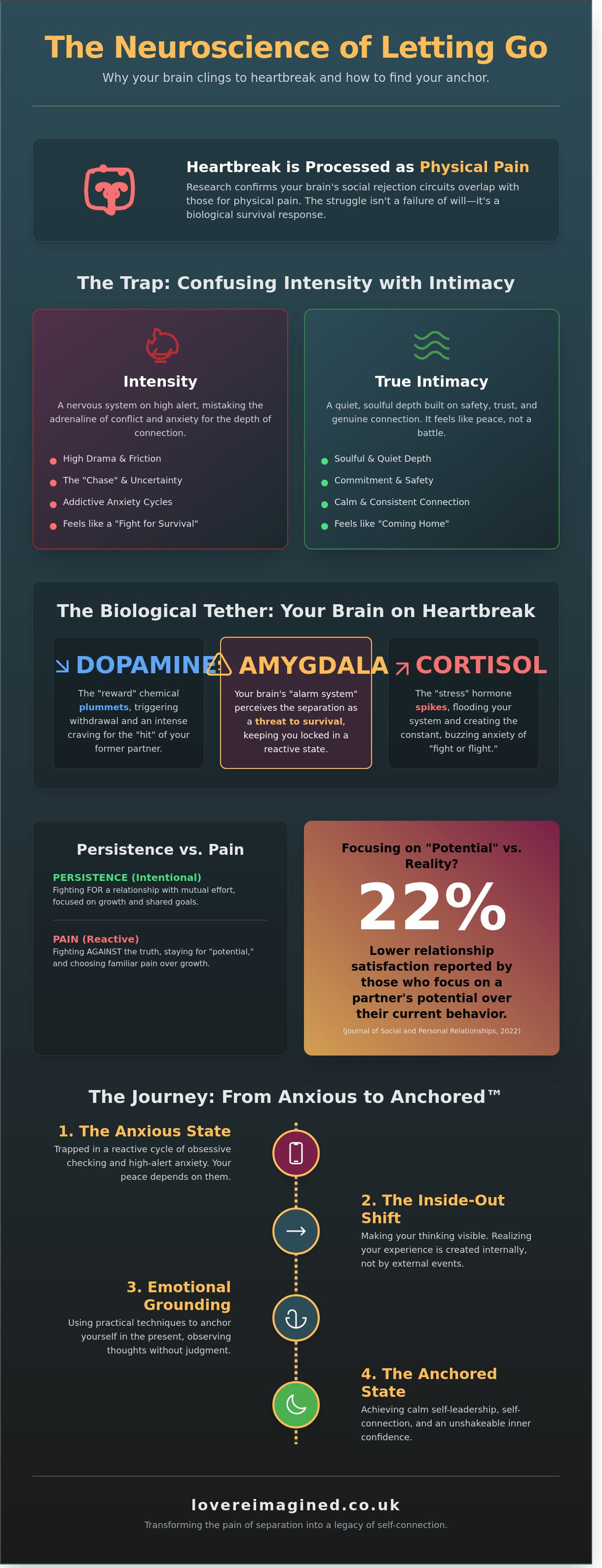
You wake at 3:00 am and your thumb instinctively finds the glass screen, scrolling through archived messages as if a new truth might suddenly appear between the lines. The blue light flickers against your face. It mirrors the cold, rhythmic ache of anxiety in your chest. It's a wearying, circular dance between a ghost of hope and the heavy reality of absence. You recognise that it is finally time to let go, yet your mind clings to the wreckage as if it were a life raft. This isn't a failure of will. Research from the University of Michigan in 2011 confirms that your brain processes this social rejection in the same regions as physical pain, making the struggle feel like a matter of survival.
You likely feel that your peace depends entirely on their silence or their return, a belief that keeps you trapped in a state of high-alert. I'll show you how to transition from this exhausting cycle into the quiet, soulful strength of neuroscience-informed self-leadership. By understanding that your experience is created from the inside out, we can begin to dissolve the push-pull of heartbreak. This article explores how to rewrite your internal script, drawing on principles from my book, Overcome Anxious Attachment, to help you move beyond the trap of obsessive checking and begin the journey toward becoming From Anxious to Anchored™.
Key Takeaways
- Recognise the distinction between the cinematic drama of intensity and the quiet, soulful depth of true intimacy to discern if it is finally time to let go of a reality that no longer serves your spirit.
- Unpack the biological tethers of heartbreak through a neuroscience-informed lens, discovering how the human mind heals as explored in Kay Tear’s Overcome Anxious Attachment.
- Master the "inside-out" shift by making your thinking visible, allowing you to move from reactive patterns into a space of intentional, calm self-leadership.
- Learn practical "Emotional Grounding" techniques to anchor yourself in the present moment, acknowledging heavy thoughts without the exhausting weight of judgement or the need to fix them.
- Discover how the From Anxious to Anchored™ programme transforms the pain of separation into a soulful legacy of self-connection and unshakeable confidence.
Recognising the Threshold: Is it Finally Time to Let Go?
Letting go is rarely a single, cinematic exit. It’s a quiet, internal release of the demand for a different reality. When we ask if it's finally time to let go, we aren't usually looking for permission to leave a person; we're seeking permission to stop the internal war. We often mistake the friction of a relationship for its fire. This is the "Intensity vs. Intimacy" trap. High drama feels like high stakes, but it’s often just a nervous system on high alert. We confuse the adrenaline of conflict for the depth of connection. We mistake the "chase" for the "commitment."
Your "Internal Script" might be whispering that your worth is a direct reflection of this person’s presence. This script suggests that if they stay, you're enough; if they leave, you're shattered. It’s a heavy burden to place on another human. Waiting for "closure" from someone else is another form of self-abandonment. It hands the key to your peace to the person who lost it in the first place. True closure is an internal realisation that the story has ended, regardless of whether the other person acknowledges the final chapter.
The Difference Between Persistence and Pain
There’s a thin, vibrating line between fighting for a relationship and fighting against the truth. Persistence is intentional; pain is reactive. When you stay for "potential," you're dating a ghost of who that person might become, rather than the human standing in front of you. This is a high-cost investment. A 2022 study by the Journal of Social and Personal Relationships found that individuals who focus on a partner's "potential" rather than their current behaviour report 22% lower relationship satisfaction. Your "Internal Script" might be choosing the familiar pain of a struggling relationship because it feels safer than the terrifying freedom of being alone. This prioritises safety over growth, keeping you tethered to a reality that no longer serves your legacy.
When Your Body Signals the End
Your body often knows the truth before your mind is ready to speak it. It’s that heavy, hollow ache in the chest or the constant, buzzing anxiety in the stomach. This is the "Oh… this is me" moment of total exhaustion. Your nervous system can become addicted to the cycle of anxiety; the highs and lows create a chemical loop that feels like passion. It isn't. It’s toxic stress. In my book, Overcome Anxious Attachment, I discuss how we must distinguish between the healthy discomfort of growth and the soul-crushing fatigue of holding on. True emotional grounding, a core pillar of the From Anxious to Anchored™ program, requires us to listen to these somatic cues. If your body is constantly in "fight or flight" mode, it's not a sign of love. It’s a signal for survival.
To understand where you sit on the spectrum of emotional grounding and self-connection, you can take the Love Reimagined Quiz to assess your current relationship patterns.
The Biological Tether: Why the Brain Refuses to Let Go
Heartbreak is not merely a sentimental ache. It is a chemical rebellion. When you decide it is finally time to let go, your brain often refuses to cooperate, clinging to the wreckage with a primal desperation. This happens because the neurochemistry of love mirrors the circuitry of addiction. When a connection severs, your dopamine levels plummet. The brain enters a state of withdrawal, craving the "hit" of your former partner with the same biological urgency a person might crave a physical substance. You are not weak. You are experiencing a neurochemical storm.
In her transformative book, Overcome Anxious Attachment, Kay Tear explores how the human mind heals by understanding its own internal architecture. The amygdala, that ancient sentinel of survival, perceives the end of a relationship as a threat to your very existence. It keeps you locked in a reactive state, flooding your system with cortisol and adrenaline. This biological response creates a compelling illusion. It whispers that your panic is a sign of "true love" rather than a physiological glitch. We must learn that fear isn't truth. Your internal script is often projecting old attachment wounds onto the present moment, making a temporary ending feel like a permanent catastrophe.
Rewiring the Anxious Brain
The electric pull you feel towards an ex is frequently mistaken for destiny. It's vital to distinguish between a genuine connection and an attachment trigger. Intensity is a neurochemical reaction, not a sign of "the one." By practising Emotional Grounding, you can begin to calm the biological noise. This technique involves shifting your focus from the external "why" of the breakup to the internal "how" of your current state. You begin to recognise that your experience is created internally through your thinking, not by the presence or absence of another person. This is a core shift in perspective. It moves you from a victim of your biology to the architect of your peace.
Breaking the Social Media Loop
Digital ghosts haunt us through the glowing glass of our phones. Every time you check their profile, you engage in intermittent reinforcement. It is a slot machine for the soul. You hope for a sign of regret or a glimpse of their life, but you usually find only fresh triggers. To break this, you must Make Thinking Visible. When the urge to scroll arises, write down the thoughts driving it. By seeing the internal script on paper, the impulse loses its hypnotic power. Setting digital boundaries is an act of self-preservation. It is about honouring your healing and protecting your capacity to move forward. If you feel stuck in a cycle of digital surveillance, taking a personal assessment of your emotional grounding can help you identify where your internal boundaries need reinforcing.
The Inside-Out Shift: Making Your Thinking Visible
The weight of a breakup often feels like a physical force, a storm that has swept away your stability. However, the core philosophy of the From Anxious to Anchored™ programme teaches that our experience isn't created by the person who left or the silence in the hallway. It's created internally through the filter of our own thinking. When you realise it is finally time to let go, you aren't releasing a person as much as you're releasing the grip you have on a specific, painful narrative. Suffering doesn't stem from the loss itself; it stems from the thought-loop that tells you this loss defines your worth.
In my book, Overcome Anxious Attachment, I explore how we assign heavy meanings to external events. You might tell yourself, "I am unlovable," or "I'll never find this connection again." These aren't facts. They are components of an internal script. Making your thinking visible allows you to see these thoughts for what they are: temporary mental energy, not objective reality. Research published in the Journal of Positive Psychology (2017) suggests that 71% of individuals begin to see positive growth within 11 weeks of a breakup when they shift focus toward self-reclamation. To understand where you currently stand, you can take the Relationship Quiz to assess your current level of Self-Connection.
Fear Isn’t Truth: Deconstructing the Narrative
The mind is a master dramatist. It takes a simple moment, like an unreturned text, and spins it into a cinematic tragedy of lifelong loneliness. Emotional Self-Leadership involves catching this script before it spirals into panic. You don't have to believe every thought that passes through your awareness. By distancing yourself from the drama, you create space for emotional grounding. You begin to see that fear isn't truth; it's just a misunderstood signal from a mind trying to protect you. This shift allows you to observe the narrative without being consumed by its intensity.
From Reactive to Intentional Living
Many people spend their energy trying to manage triggers, but this is an exhausting, reactive way to live. True Unshakeable Confidence comes from understanding the source of the feeling rather than policing the environment. It's that profound "Oh… this is me" moment when you realise the discomfort you feel is your own thinking in the moment, not a reflection of your safety or future. You are safe regardless of the relationship's outcome. Transitioning to intentional living means you stop trying to control the world to feel okay. Instead, you lean into the quiet, unfiltered truth of your own resilience. You aren't just surviving the end of a story; you're reimagining your role as the author of your legacy.
Emotional Self-Leadership: Practical Steps to Anchor Yourself
When you accept that it is finally time to let go, the weight of the past does not simply vanish; it transforms. Emotional self-leadership is not about controlling your environment or waiting for an apology that may never arrive. It's about anchoring your identity within yourself. This shift requires a move from being a passenger in your own mind to becoming an intentional observer of your internal landscape. In my work as an ICF-accredited coach, I see how this core shift moves individuals from reactive patterns to a state of unshakeable confidence.
- Step 1: Acknowledge the current thought without judgement. Witness the thought as a passing cloud rather than a permanent weather system. You don't need to fix it to find peace.
- Step 2: Practice "Emotional Grounding" to return to the present moment. This interrupts the nervous system's attempt to live in a future that hasn't happened or a past that is gone.
- Step 3: Use the Stop the Spiral framework to interrupt obsessive loops. This tool is essential for making thinking visible and breaking the "intensity" that we often mistake for intimacy.
- Step 4: Re-evaluate the "Legacy" of the relationship. Ask yourself what the connection is really teaching you about your own needs and boundaries, rather than focusing on the other person's failures.
- Step 5: Commit to an "Inside-Out" daily practice of self-observation. Recognise that your feelings are a direct reflection of your thinking in the moment, not a report on the state of your life.
The Art of Emotional Grounding
Grounding is a physiological bridge back to safety. When your nervous system is dysregulated, try the 5-4-3-2-1 sensory exercise. Identify five things you see, four you can touch, three you hear, two you smell, and one you can taste. This isn't a distraction technique; it's a way to signal to your brain that you're safe in the now. Calm and clear-minded living is a skill you build through repetition, much like a muscle. By focusing on your breath and body awareness, you break the anxious cycle that keeps you tethered to old pain. It's about finding the "centre" amidst the storm.
Creating Your New Internal Script
Your healing depends on the narrative you tell yourself. If your internal script is "I wasn't enough," your experience will be one of lack. In my book, Overcome Anxious Attachment, I explore how we can shift from "Why did they leave?" to "How do I want to feel today?" This isn't about toxic positivity. It's about honouring the quiet in between moments where growth actually happens. When you realise it's finally time to let go, you stop performing for an audience of one and start living for yourself. You begin to value substance and artistic depth in your own life story.
Are you ready to move from reactive patterns to a grounded sense of self? Take the Emotional Grounding Quiz to see where you stand on your journey to unshakeable confidence.
Reimagining Your Legacy: Beyond the Heartbreak
Deciding it's finally time to let go is a profound act of self-authorship. It marks the moment you stop being a character in a story written by your past and start documenting a legacy built on authenticity. This transition isn't about erasing what happened. It's about shifting your internal script. You're moving away from the performance of love and toward the quiet, steady pulse of internal peace. Your future isn't a reaction to your heartbreak; it's a reimagined expression of your truest self. When you realise it's finally time to let go, you are choosing to prioritise your peace over your history.
Building Secure Foundations
Being Anchored means you no longer drift in the wake of another person’s whims. It's a state of emotional grounding where your worth isn't negotiated daily. In this space, you recognise that intensity is not the same as intimacy. A 2021 study in the Journal of Social and Personal Relationships highlighted that individuals with secure attachment patterns experience a 42% reduction in chronic relationship stress compared to those with anxious patterns. You begin to see secure attachment signs in others: consistency, transparency, and a lack of games. This allows for an unfiltered connection. You can finally be seen because you are no longer afraid that being known will lead to being left.
Your Invitation to the Love Reimagined Method™
The journey from heartbreak to wholeness requires more than just time; it requires a core shift in how you perceive your reality. My Anxious to Anchored™ programme utilises neuroscience-informed insights to help you understand that your experience is created from the inside out. As I discuss in my book, Overcome Anxious Attachment, your feelings are a compass for your thinking, not a map of your external world. By making your thinking visible, you stop being a victim of your triggers and become a Human Experience Specialist in your own life.
This is your invitation to stop the spiral and start building unshakeable confidence. You deserve a love that feels like a sanctuary, not a battlefield. Your legacy is not the pain you endured, but the resilience you cultivated. It's time to document a new story, one where you are the anchor in your own storm. You are not just recovering; you are evolving.
Reclaiming the Narrative of Your Heart
Healing isn't an act of erasure; it's a profound reclamation of your own energy. You've seen how the brain's biological tether keeps you bound to what was, yet by making your thinking visible, you can dismantle the internal script that keeps you in a state of reaction. It's about recognising that your experience is created from the inside out. When the weight of the past outweighs the joy of the present, it's finally time to let go and anchor yourself in the truth of who you are becoming. This isn't just about moving on; it's about shifting from intensity to true intimacy.
Kay Tear, a Business Psychologist, ICF-accredited coach, and author of "Overcome Anxious Attachment", created the neuroscience-informed Love Reimagined Method™ to guide you through these core shifts. You can move beyond the "Oh… this is me" realisations into a life of unshakeable confidence. To start your journey from reactive to intentional, take the Love Reimagined Quiz to find your path from Anxious to Anchored™. Your legacy isn't defined by the heartbreak you've endured, but by the quiet, beautiful strength you find in the space that follows.
Frequently Asked Questions
How do I know if it is finally time to let go or if I should keep trying?
You know it is finally time to let go when the emotional cost of staying consistently exceeds the joy of the connection. If 85% of your mental energy is spent navigating an internal script of doubt rather than experiencing genuine intimacy, the relationship has become a weight. It's a quiet, heavy realization. You stop trying to edit a story that has already reached its final page; you choose peace over the performance of persistence.
Why does letting go of someone I love feel so physically painful?
Physical pain during heartbreak is a visceral response to your nervous system losing its familiar rhythm. A 2011 study from the University of Michigan confirmed that social rejection activates the same neural pathways as physical burns. Your body is experiencing a chemical withdrawal from the intensity you once felt. This isn't a sign that you've made a mistake; it's simply your "Inside-Out" experience manifesting as a physical sensation of loss.
Can I still let go if I don’t have closure from my ex?
You can find complete peace without a final conversation because closure is an internal shift rather than an external gift. Waiting for an ex to explain their choices keeps you tethered to a narrative you cannot control. In my book, "Overcome Anxious Attachment", I explore how we often mistake an explanation for healing. You create your own ending by making your thinking visible and deciding that their silence is all the information you need.
How long does it typically take to finally let go after a long-term relationship?
While research in the Journal of Positive Psychology (2007) suggests many individuals feel a significant shift after 11 weeks, the timeline depends on your internal processing. Recovery isn't a race against a calendar; it's a journey of emotional grounding. Those who engage with the From Anxious to Anchored™ program often find that addressing their internal script accelerates the process. You don't just wait for time to pass; you intentionally reimagine your sense of self.
What is the "Inside-Out" approach to healing from heartbreak?
The "Inside-Out" approach is the radical understanding that your feelings of despair are created by your thoughts about the breakup, not the breakup itself. Instead of trying to fix external circumstances, you focus on the core shift of recognizing that your security lives within you. This perspective allows you to move from a reactive state to one of calm clarity. It's about documenting your feelings with honesty rather than being trapped by them.
How can I stop my brain from constantly replaying old memories?
You can halt the loop by recognising that these memories are just thoughts appearing in the present moment, not a literal reflection of your current value. Your brain often offers a "highlight reel" to find safety in the familiar, even if that familiar was painful. By practising emotional grounding, you can observe these mental images without boarding the train. You learn to distinguish between the memory's intensity and the reality of your present, unfiltered life.
Will I ever be able to have a secure relationship after being so anxious?
A secure, beautiful relationship is entirely possible once you transition from an anxious internal script to an anchored state of being. Security is not a personality trait you are born with; it's a result of understanding how your mind creates your experience. When you stop viewing fear as truth, you open space for authentic, intentional connection. This transformation is the legacy you leave for your future self, ensuring your next chapter is written with substance and depth.
If you're ready to move from reactive patterns to unshakeable confidence, take our assessment quiz to measure your Emotional Grounding, Boundaries, and Self-Connection. Discover where you stand on your journey toward becoming From Anxious to Anchored™ and start building the loving relationships you deserve.