
Understanding Fearful Avoidant Attachment: The Path from Emotional Chaos to Inner Peace
Last Tuesday, Sarah sat in a quiet London cafe, watching her partner reach for her hand and feeling an immediate, visceral urge to pull away. To the outside world, she's a portrait of composure; inside, she feels like a walking contradiction, trapped in the exhausting push-pull of fearful avoidant attachment. You likely recognise this frantic rhythm, where the high-voltage intensity of anxiety is mistaken for the soulful depth of intimacy. It's a heavy burden to carry, constantly scanning for micro-shifts in a partner's mood while your nervous system screams for both closeness and escape.
You probably believe that your safety depends on this hyper-vigilance, yet you long for a connection that feels like a legacy rather than a temporary truce. In my book, Overcome Anxious Attachment, I share that your experience is created from the inside out. Your distress stems from an internal script rather than external circumstances. This article will show you how to navigate these waves by reimagining your narrative and building unshakeable emotional grounding. We'll explore the core shifts from my From Anxious to Anchored™ programme to help you stay present, move past the fear, and finally inhabit a space of intentional peace.
Key Takeaways
- Recognise how your internal script shapes your reality, revealing why fearful avoidant attachment is an experience created by your thinking rather than your partner’s actions.
- Distinguish the intoxicating 'spark' of a dysregulated nervous system from the quiet, soulful depth of authentic intimacy.
- Shift from a life of reaction to one of intention by embracing the From Anxious to Anchored™ philosophy to ground your internal world.
- Begin documenting a new narrative for your future relationships through the Love Reimagined Method™, prioritising internal peace over emotional chaos.
- Uncover why the path to a secure legacy begins with healing the internal relationship with yourself rather than simply managing external triggers.
What is Fearful Avoidant Attachment? The Push-Pull Paradox
Imagine a landscape where the horizon shifts every time you step toward it. This is the visceral reality of fearful avoidant attachment, a state of being often described as disorganised because it lacks a single, predictable strategy for connection. You aren't simply "hard to read"; you're navigating an internal script that views intimacy as both the ultimate prize and the ultimate threat. While the anxious-preoccupied style focuses on closing the gap at all costs, the fearful-avoidant experience is a complex hybrid. It's a restless oscillation between needing to be seen and needing to disappear. When you're alone, the longing is a physical ache. When they get close, that same proximity feels like a cage.
This push-pull dynamic isn't a choice, but a response to an "inside-out" perspective where your internal world projects danger onto safe situations. You might find yourself craving a deep, soulful legacy of love, yet your mind perceives the vulnerability required to get there as a life-threatening risk. In my book, Overcome Anxious Attachment, I explore how we frequently mistake intensity for intimacy, sabotaging the very peace we claim to seek because our internal wiring is set to "detect" rather than "connect".
The Core Conflict: Safety vs. Vulnerability
The heart seeks a legacy of connection, yet the brain remains hyper-vigilant. You might experience the sudden "ick" after a period of beautiful vulnerability, or find yourself picking a fight just as things start to feel "too good". According to a 2011 meta-analysis by Bakermans-Kranenburg and van IJzendoorn, disorganised attachment affects roughly 7% of the general population, manifesting as a profound lack of a coherent strategy for dealing with stress. These aren't random moods; they're attempts to regain control when the "danger" of being known becomes too loud. Fearful avoidance is essentially a nervous system stuck between the survival instinct to attach for safety and the survival instinct to flee from perceived harm.
Recognising the 'Oh... This is Me' Moments
These patterns often hide in plain sight, disguised as personality quirks or "high standards". They are the quiet, staccato observations of a mind that hasn't yet found its anchor. You might recognise yourself in these common behaviours:
- Hyper-analysing the subtext of a text message or a partner's slight change in tone for hours.
- Feeling a surge of panic or "trapped" energy when a partner suggests a future commitment.
- Ghosting someone you genuinely like because the connection felt "too intense" or "too fast".
- Creating distance through workaholism or "checking out" emotionally after a great date.
These aren't flaws; they're protective mechanisms of an unanchored mind trying to preserve its autonomy. To understand where you sit on this spectrum and begin making your thinking visible, I invite you to take the Love Reimagined Quiz to assess your current level of self-connection and emotional grounding.
The Internal Script: Why Your Brain Mistrusts Connection
We often believe our emotional pain is a direct consequence of a partner's actions. We tell ourselves that their silence causes our anxiety or their distance creates our despair. However, experience is created internally. It is a projection of an internal script, a narrative written long ago that continues to direct the actors in your current life. For those navigating fearful avoidant attachment, love was rarely a sanctuary. It was a landscape of unpredictability where the same person who provided care also represented a source of alarm. This creates a disorganised blueprint for intimacy. Your brain learns to mistrust peace because the familiar sting of chaos feels safer than the terrifying unknown of true vulnerability.
The trauma loop ensures the mind seeks out what it knows, even if what it knows is painful. Fear isn't truth; it is merely a sensory echo of the past playing in the present moment. When you feel that sudden surge of panic, it is rarely about the person standing in front of you. It is a ghost from a previous chapter, a thought-generated shadow that obscures the reality of your current connection. Understanding that your feelings are coming from your thinking, not your circumstances, is the first step toward reclaiming your agency.
The Role of the Nervous System in Attachment
When a romantic partner pulls away, your nervous system doesn't just feel a sting of rejection. It enters a state of total high alert. The internal script triggers a fight, flight, or freeze response that feels visceral and life-threatening. You might find yourself flooded by a simple emotional demand, feeling a sense of drowning in the other person's needs. In her book, Overcome Anxious Attachment, Kay Tear explains that understanding the mechanics of the human mind is the essential foundation for healing. Without this clarity, you remain a passenger to your own biological reactions. Recognising that this intensity is not the same as intimacy allows you to begin the process of emotional grounding.
Making Thinking Visible: Identifying Your Stories
To heal, you must begin the work of making thinking visible. When your partner is quiet, what is the immediate meaning you assign to that silence? You might decide they are bored, or perhaps they are already planning their exit. These are not observations; they are internal projections that create unnecessary suffering. A 2023 study published in the Journal of Social and Personal Relationships highlighted that individuals with high attachment anxiety are 35% more likely to misinterpret neutral facial expressions as hostile or rejecting. This misfiring of the mind creates a bridge to a past that no longer exists.
- Distinguish between threats: Is there a real-world red flag, or is this a thought-generated fear?
- Observe the narrative: Watch the story your mind builds around a text message or a missed call.
- Anchor in the present: Realise that your safety comes from within, not from the perfect behaviour of another.
This shift from reactive survival to intentional presence is the core of the From Anxious to Anchored™ programme. By identifying the stories you tell yourself, you stop being a victim of your history and start becoming the architect of your future legacy.
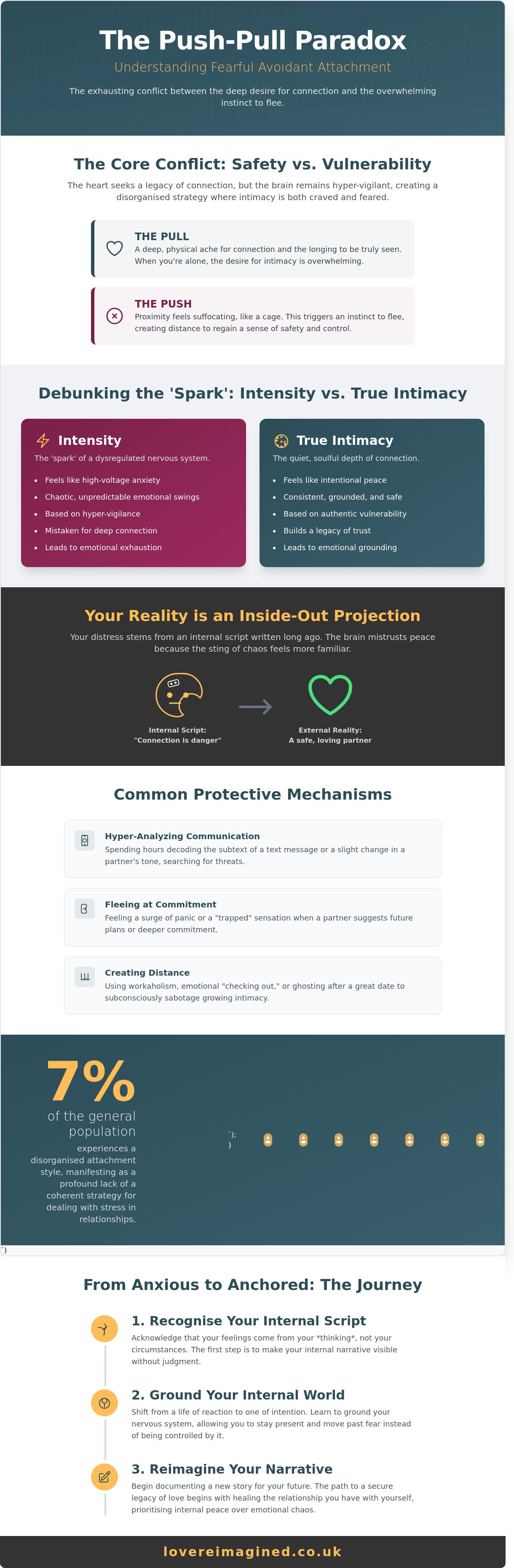
Intensity vs. Intimacy: Debunking the Myths of Fearful Avoidance
The electric surge of a new connection often feels like destiny. It is a cinematic pull, a gravity that demands your absolute attention. For someone navigating fearful avoidant attachment, this 'spark' is frequently mistaken for a soulmate encounter. In reality, it is often the nervous system screaming in high-arousal fear. We confuse the racing heart of anxiety with the fluttering of butterflies. This is a central theme I explore in my book, Overcome Anxious Attachment; our experience of love is created by our internal thinking, not the person standing in front of us.
Peace often feels unsettling, even wrong. To a mind accustomed to the jagged peaks and valleys of disorganized attachment, a calm relationship can feel like a flatline. It feels boring. We have been conditioned to believe that if it doesn't hurt or consume us, it isn't real. This internal script suggests that intensity equals depth, but intensity is merely a shadow of true intimacy.
This is a core shift in perspective. We must move from seeking the temporary high of romantic excitement toward the enduring legacy of unshakeable confidence and calm. Healing begins when we stop asking if the other person is 'the one' and start asking if we feel anchored within ourselves. You can begin this process by taking our Relationship Assessment Quiz to evaluate your current level of emotional grounding.
Why 'Chemistry' Can Be a Warning Sign
Research from the University of Hertfordshire suggests that up to 60% of individuals can misinterpret physiological arousal, such as fear or stress, as romantic attraction. We are often drawn to other avoidant partners who mirror our own internal chaos, creating a feedback loop of 'intensity spikes' that we mistake for connection. Instead of chasing the high, we must look for anchored values. True connection is found in the unfiltered moments of stillness, not the performative drama of the chase.
The Trap of Hyper-Vigilance
Hyper-vigilance is a ghost that haunts the fearful avoidant. You spend your energy scanning for red flags, convinced that if you can just predict their next move, you will be safe. This isn't protection; it's a form of managing triggers that keeps you trapped in a reactive state. It prevents you from seeing the person as they truly are. True security comes from emotional grounding, not from perfectly predicting a partner's every move.
Within the From Anxious to Anchored™ program, we focus on making thinking visible. When you realise your fear is a product of your internal script rather than an external threat, you stop being a passenger to your own panic. Safety is an inside job. It is the quiet confidence that you can handle whatever arises, regardless of how another person chooses to show up.
Healing the Fragmented Self: Practical Steps for Emotional Grounding
True healing begins when we stop trying to fix the person across from us and start tending to the landscape within. For those navigating the turbulence of fearful avoidant attachment, the instinct is often to look outward for a stabilising force. We search for the right partner, the right words, or the right reassurance to quiet the internal storm. However, the From Anxious to Anchored™ philosophy suggests a radical departure from this pattern. It posits that your sense of safety is not a gift granted by another, but a legacy you build with yourself.
In my book, Overcome Anxious Attachment, I explore how our experience is created from the inside out. We don't feel the world; we feel our thinking about the world. When you realise that your emotional chaos is the result of an internal script rather than external reality, the need to "manage" every trigger dissolves. You aren't broken. You're simply caught in a cinematic illusion of your own mind's making. Building a secure base within means becoming the witness to your thoughts rather than their captive.
Developing Self-Connection and Boundaries
Boundaries are frequently misunderstood as walls we build to keep others out. In the context of healing, boundaries are actually the clarity we maintain regarding what we allow to take root in our own minds. It's about deciding which thoughts deserve your energy and which are merely noise. When you feel an emotional spiral beginning, you must make your thinking visible. This isn't a clinical exercise; it's an act of self-leadership. You can find immediate tools for this in the Stop the Spiral resource, which helps ground you when the urge to flee or fight becomes overwhelming.
- Acknowledge the Sensation: Notice the physical tightness in your chest or the heat in your face without naming it "bad."
- Externalise the Script: Write down the exact sentences your mind is shouting. Seeing them on paper strips them of their power.
- The Truth Audit: Ask if the thought is a documented fact or an old, recycled fear.
Setting Boundaries with Your Own Thoughts
The Core Shift occurs when you stop treating every fearful thought as an objective truth. For someone with fearful avoidant attachment, thoughts often feel like urgent commands to run. Instead, try viewing them as weather patterns. A storm might be intense, but it isn't the sky. Emotional grounding allows for a sacred pause between the feeling of fear and the reaction of avoidance. This pause is where your freedom lives. By observing the impulse to push someone away without actually acting on it, you prove to your nervous system that you are safe in the present moment. This internal reliability is the foundation of unshakeable confidence.
Are you ready to move from reactive patterns to intentional living? Take the Emotional Grounding Quiz to see where you stand on your journey to becoming anchored.
Reimagining Love: The Journey to Becoming Anchored
Moving beyond the storm of fearful avoidant attachment is less about finding the right person and more about becoming the right person for yourself. It is a profound transition from a life of constant, visceral reaction to one of quiet, soulful intention. For many, this path feels like learning a new language; one where the vocabulary of fear is replaced by the grammar of security. This work is deeply personal and must be undertaken individually before it can ever be successfully mirrored in a partnership. You are not just fixing a relationship pattern; you are crafting a new legacy of love that will echo through your future. By choosing to heal, you ensure that the chaos of the past does not become the blueprint for your tomorrow.
The Love Reimagined Method™: A New Blueprint
The Love Reimagined Method™ serves as a visceral documentation of your evolution. By utilising neuroscience-informed coaching, we work to rewire the neural pathways that have kept you trapped in cycles of hyper-vigilance and withdrawal. This is the essential inside-out shift: a fundamental realisation that your experience is created by your internal script rather than your external circumstances. When you transform your inner narrative, the way you perceive connection changes. For those seeking a bespoke, deeply transformative experience, 1:1 Private Coaching provides the intimate support needed to make your thinking visible and reclaim your narrative. This process moves you from the performative nature of "trying to be secure" to the authentic state of actually being anchored.
Building Unshakeable Confidence in Dating
Stepping into the dating world from an anchored state feels entirely different from the frantic energy of the past. It is a state of being calm, clear-minded, and intentional. You no longer look for red flags with a racing heart; instead, you observe from a place of emotional grounding. Recent studies suggest that approximately 25% of adults navigate some form of avoidant attachment, yet your story does not have to be a statistic. You begin to understand that suffering doesn't come from love itself, but from the meaning your thinking attaches to every silence or perceived slight. It is the vital difference between intensity and true intimacy. To deeply explore this philosophy and find your footing, the book Overcome Anxious Attachment serves as the definitive guide for this journey. It offers the tools to build unshakeable confidence and move past the limitations of fearful avoidant attachment once and for all.
Your journey from emotional chaos to inner peace is an act of bravery. It is an invitation to be your most authentic self without the pressure of tradition or the weight of old wounds. Commit today to the version of yourself that is anchored. Your legacy of healthy, secure love begins the moment you decide that your internal peace is worth the work.
Reimagining Your Path to Anchored Connection
The exhausting push and pull of fearful avoidant attachment doesn't have to define your legacy. You've discovered that true connection isn't found in the high-stakes drama of intensity, but in the quiet, steady pulse of genuine intimacy. By making your thinking visible, you begin to dismantle the internal script that falsely equates safety with a threat. Healing is never about simply managing external triggers; it's about a profound core shift in how you inhabit your own mind. It's about recognising that your experience is created from the inside out, not by the actions of others.
Founded by Business Psychologist Kay Tear, our neuroscience-informed Love Reimagined Method™ provides the architectural blueprint for this transformation. As Kay explores in her book, 'Overcome Anxious Attachment', when you stop mistaking fear for truth, you create space for a relationship that feels like a sanctuary rather than a battlefield. It's time to stop performing and start being. You deserve a love that feels anchored, unfiltered, and entirely yours. Your story is still being written, and the most beautiful chapters are the ones where you finally feel at home within yourself.
Take the Attachment & Emotional Grounding Quiz to start your journey
Frequently Asked Questions
Can a fearful avoidant ever become securely attached?
Yes, moving from a fearful avoidant attachment style to a secure one is entirely possible through the work of rewriting your internal script. It isn't a permanent personality trait but a survival strategy born from past emotional noise. By making thinking visible, you move from the chaos of reactive patterns toward a steady, grounded presence. This shift allows for genuine intimacy without the frantic need to flee or the crushing weight of performance.
What is the difference between fearful avoidant and dismissive avoidant?
The primary difference lies in the internal conflict and the level of physiological anxiety experienced. While a dismissive avoidant often feels self-sufficient and views closeness as unnecessary, someone with fearful avoidant attachment desperately craves connection yet fears the vulnerability it requires. Research from the Gottman Institute suggests that 20% of the population struggles with avoidant patterns. FAs experience high anxiety and high avoidance, whereas DAs typically report lower levels of distress regarding their independence.
Why do I feel 'the ick' so suddenly when someone shows interest in me?
That sudden "ick" is your internal alarm system mistaking intimacy for a threat to your safety. When someone shows genuine interest, your internal script interprets this as a loss of autonomy or a precursor to inevitable rejection. In my book, Overcome Anxious Attachment, I explore how we often confuse intensity with intimacy. This visceral reaction is a creative way your mind tries to protect you. It isn't a reflection of the other person's value.
How do I tell my partner that I have a fearful avoidant attachment style?
Share your experience as a journey of self-discovery rather than a clinical diagnosis to keep the conversation intimate. Explain that you're working on making thinking visible and that your occasional need to withdraw is a strategy for emotional grounding. You might say, "I've realised I have a fearful avoidant attachment style, which means I sometimes feel overwhelmed by closeness." This transparency invites them into your world and replaces the performance of being okay with truth.
Does fearful avoidant attachment always come from childhood trauma?
While roughly 80% of those with this style experienced disorganised caregiving in childhood, it isn't the only origin story. Traumatic adult experiences, such as a particularly volatile divorce or a betrayal that cost you £10,000 in legal fees, can also reshape your internal script. Healing happens when you realise that your current suffering comes from the meaning you're giving to those memories today. Fear isn't truth; it is simply a reflection of your current thinking.
How long does it take to heal from fearful avoidant patterns?
There is no fixed stopwatch for healing, but significant core shifts often occur within 12 weeks of intentional work. My From Anxious to Anchored™ programme focuses on the inside-out nature of experience to accelerate this process. As noted in Overcome Anxious Attachment, the moment you stop trying to manage external triggers and start understanding how your mind creates your reality, the timeline shrinks. You aren't fixing a broken machine; you're clearing a lens.
Is fearful avoidant attachment the same as BPD (Borderline Personality Disorder)?
They share similarities, such as a fear of abandonment, but they aren't the same psychological construct. A study published in the Journal of Personality Disorders in 2018 found that while many with BPD exhibit fearful avoidant patterns, the attachment style is a specific relational strategy rather than a clinical personality disorder. Attachment is about the internal script of relationships. BPD involves a broader range of emotional dysregulation that impacts every facet of a person's life.
Can two fearful avoidants have a successful relationship?
Two fearful avoidants can build a beautiful legacy if both are committed to making thinking visible. Without this awareness, the relationship often mirrors a cinematic tragedy of missed connections and high-intensity conflicts. However, when both partners understand that their experience is created internally, they can support each other's need for space without taking it personally. It requires a reimagining of love. The relationship moves from a performance of perfection to a shared, unfiltered experience.