
Online Therapy and Beyond: Reimagining Connection from the Inside Out
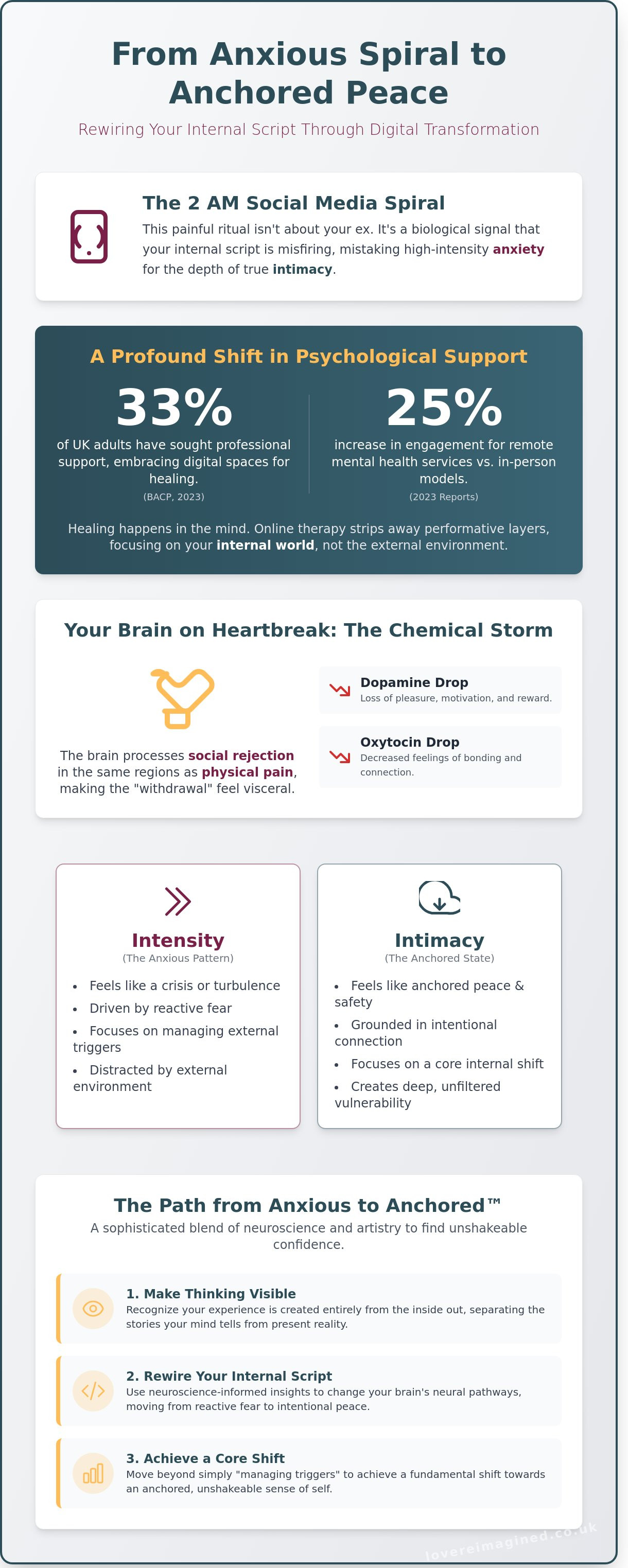
It’s 2:00 AM, and the blue light of your phone illuminates a familiar, painful ritual: scrolling through an ex’s social media feed to find a sign that they’re hurting as much as you are. What if this frantic spiral isn't actually about them, but a biological signal that your internal script is misfiring? You’ve likely been told that time heals all wounds, yet you still find yourself mistaking high-intensity anxiety for the depth of true romantic intimacy. It’s exhausting to feel powerless against your own mind, but through the accessibility of online therapy, you can begin to dismantle the unworthiness that dictates your reactions.
According to a 2023 study by the British Association for Counselling and Psychotherapy (BACP), 33% of UK adults have sought professional support, moving away from clinical settings toward more intimate, digital spaces. This article promises to show you how online psychological support can rewire your internal script, moving you from the turbulence of anxious attachment to a state of unshakeable, anchored peace. We’ll explore the neuroscience behind your heartbreak and how making your thinking visible can transform your reactive fear into a foundation for legacy-worthy love.
Key Takeaways
- Understand how online therapy acts as a profound vessel for internal transformation, allowing you to rewire your nervous system and bridge the gap between digital interaction and soulful connection.
- Learn to distinguish between the intensity of a moment and true intimacy by making your thinking visible and recognising that your experience is created entirely from the inside out.
- Discover why moving beyond "managing triggers" to achieving a core shift is the essential key to transitioning from the turbulence of anxious attachment to an anchored sense of self.
- Gain practical steps for creating a dedicated "Sanctuary Space" that facilitates deep psychological work, ensuring your physical environment supports the internal peace you are cultivating.
- Explore how the From Anxious to Anchored™ programme reimagines the path to secure attachment, offering a sophisticated blend of neuroscience and artistry to help you find unshakeable confidence.
Beyond the Screen: Understanding Online Therapy in a Digital Age
For many years, Online counseling was viewed as a logistical compromise, a secondary choice for those who couldn't attend a physical clinic. We're now seeing a profound shift. Online therapy isn't just a digital alternative; it's a specialised medium for internal transformation. Healing happens in the mind, regardless of where your feet are planted. This is the "inside-out" nature of experience. Your world is felt through your thinking, not your circumstances. When we move the work into the digital space, we strip away the performative layers of the traditional clinical office.
The Evolution of Digital Healing
The landscape of psychological support has evolved toward more intentional, specialised online programmes. In the UK, women are increasingly choosing bespoke digital coaching over traditional local settings. They're seeking depth. They're looking for an ICF-accredited or Business Psychologist led approach that values high-level growth over simple maintenance. This isn't about "managing triggers" in a draughty room. It's about creating a legacy of emotional health from the comfort of your own sanctuary. By 2023, reports indicated that remote mental health services saw a 25% increase in engagement compared to traditional in-person models, as clients prioritised specialised expertise over physical proximity.
Intensity vs Intimacy in the Virtual Room
There's a vital distinction between the "intensity" of a crisis and the "intimacy" of a true therapeutic connection. In a physical room, we often get distracted by the therapist's presence or the aesthetics of the space. Online, the screen acts as a mirror. It helps you focus on your internal script rather than the external environment. This unique digital intimacy facilitates a deeper vulnerability. You're in your own home, surrounded by your own life, yet you're exploring your deepest fears. It’s an unfiltered experience that allows for a profound sense of safety.
This is the core of The Anxious to Anchored Programme™. We use this focused environment to help you make your thinking visible. As I discuss in my book, Overcome Anxious Attachment, your experience is created internally. Fear isn't truth; it's a reflection of your current thought process. To move forward, you need emotional grounding. This foundation allows you to distinguish between the stories your mind tells and the reality of the present moment. It's the first step toward unshakeable confidence and reimagining what it means to be truly connected.
The Neuroscience of Digital Connection: Rewiring Your Internal Script
Your brain is an exquisite storyteller. It weaves narratives from pulses of light and sound, often mistaking the echo of a memory for the weight of reality. When you engage in online therapy, your nervous system isn't just reacting to a pixelated image; it's responding to the internal script you've written about intimacy. Fear often whispers that a screen is a barrier to genuine connection. However, neuroscience teaches us that fear isn't truth. It's a physiological response to a perceived threat, often rooted in past scripts rather than present facts. The Love Reimagined Method™ centres on this understanding, using neuroscience-informed insights to guide you from a state of reactive fear to one of intentional peace.
How Your Brain Falls in (and out of) Love Online
Heartbreak is a chemical storm. When a relationship ends, the brain experiences a sharp drop in dopamine and oxytocin, mimicking the symptoms of physical withdrawal. A 2021 study published in Biological Psychiatry noted that the brain processes social rejection in the same regions as physical pain, which is why the "withdrawal" feels so visceral. You don't need a mahogany desk or a therapist's couch to rewire these pathways. Neural plasticity happens wherever awareness is present. By using digital tools to facilitate Telebehavioral health, we make thinking visible. We map out the internal script on screen, allowing you to see your thoughts as separate from your identity. It's a process of documenting the story of your mind, ensuring that the legacy you build is one of clarity rather than chaos.
Regulating the Nervous System from Home
Traditional clinical settings can inadvertently trigger the "fawn" response. This is a survival mechanism where you subconsciously try to please the practitioner or perform the role of a "good patient." Working from your own sofa changes the power dynamic. It allows for genuine emotional grounding in a space where you already feel secure. As explored in Kay Tear’s book, suffering doesn't stem from the event itself but from the meaning your mind assigns to it. In our online therapy sessions, we practice techniques like sensory anchoring and breath-pacing to return to the present. You learn to distinguish intensity from intimacy. You start to realise that the familiar environment of your home can be a sanctuary for transformation rather than a cage for old habits.
- From: "I need to be physically near someone to feel safe."
- To: "Safety is an internal state I can access anywhere, regardless of the distance between us."
If you're curious about how your own attachment patterns influence your digital interactions, you might find it helpful to take the Emotional Grounding quiz to see where your internal script currently sits.
Navigating the Landscape: Online Therapy vs. Attachment-Focused Coaching
Traditional online therapy often provides a vital space for processing the echoes of the past, yet many individuals find themselves trapped in a cycle of weekly venting that lacks a clear destination. It's the difference between describing the rain and learning how to shift the weather within. While counselling focuses on the "why" of your history, the Love Reimagined Method™ prioritises the "how" of your present experience. We move beyond simply managing triggers; we facilitate core shifts that alter your entire internal architecture. This isn't about surviving your anxiety, but about dismantling the mechanics that create it.
A common hesitation involves whether coaching carries the same weight as clinical practice. Kay Tear bridges this gap as a Business Psychologist and ICF-accredited coach, ensuring every session is rooted in psychological rigour and human experience. As noted in research regarding Technology and the Future of Mental Health Treatment, the digital landscape is rapidly evolving to offer more specialised, evidence-based interventions that go beyond basic talk therapy. This approach doesn't just offer a listening ear; it provides a structured pathway to unshakeable confidence.
When to Choose a Specialist over a Generalist
Generic dating advice often suggests superficial fixes like "waiting to text" or "looking for red flags." These tropes fail because they ignore the deep-seated attachment wounds that drive your behaviour. You might experience an "Oh... this is me" moment when you realise you've been caught in the anxious-avoidant trap for years, mistaking high-octane intensity for genuine intimacy. The From Anxious to Anchored™ programme is designed for those who are tired of open-ended sessions and ready for a structured transformation. We focus on the following:
- Moving from reactive "trigger management" to proactive emotional grounding.
- Understanding that your experience is created internally, not by a partner's text or silence.
- Replacing the exhausting search for external validation with a deep, soulful self-connection.
The Role of the Internal Script
Your life is felt through your thoughts, not your circumstances. In her book, Overcome Anxious Attachment, Kay Tear explains that "fear isn’t truth." It's merely a symptom of your current internal script. Specialised coaching helps you by making thinking visible, allowing you to see the hidden narratives that dictate your relationship choices. Instead of monitoring a partner's every move, you learn to monitor your internal state. You can begin to uncover these narratives by taking the Love Reimagined Quiz, which assesses your emotional grounding and current relationship scripts. By reimagining these internal stories, you stop being a passenger in your own life and start becoming the architect of your connection.
Making Thinking Visible: A Practical Guide to Online Transformation
Transformation isn't a passive event; it's a deliberate, soulful act of reclaiming your internal narrative. When you engage in online therapy, the digital space becomes a sanctuary where you make your thinking visible. It's a cinematic process of zooming out from the noise of daily life to focus on the quiet, profound shifts happening within your own mind. To move from reactive anxiety to intentional peace, you must treat your digital sessions with the same reverence as a physical pilgrimage.
- Step 1: Creating a Sanctuary Space. Your environment mirrors your internal state. Choose a room where you won't be interrupted, light a candle, or hold a grounding object. This physical ritual signals to your nervous system that it's safe to be unfiltered.
- Step 2: The Inside-Out Shift. Move beyond the narrative of "what happened" this week. Instead, investigate how you are thinking about what happened. This is the core of the From Anxious to Anchored™ philosophy; your experience is created by your thoughts, not your circumstances.
- Step 3: Utilising Digital Anchors. Reinforce new neural pathways between sessions by engaging with curated resources. My book, Overcome Anxious Attachment, serves as a vital companion to your sessions, providing a framework for understanding the human mind.
- Step 4: Tracking Emotional Grounding. Success isn't measured by a change in your relationship status. It's measured by your level of emotional grounding. According to a 2021 study by the Journal of Psychological Disorders, digital interventions for anxiety showed a 67% improvement in patient outcomes when combined with consistent internal tracking and self-observation.
Preparing for Your First Session
Technical readiness is the baseline, but emotional preparation is the real work. Before you log on, set a heart-centred goal that focuses on your internal state rather than fixing someone else's behaviour. It's vital to distinguish between "venting," which often keeps you looped in old stories, and "transformational work" in an online therapy setting. Be authentic and raw. Speak the truths you usually hide; this is where the unshakeable confidence begins to take root.
Integrating the Work into Your Legacy
Your healing journey is the blueprint for your future emotional legacy. It's not a temporary fix for heartbreak, but a reimagining of how you show up in every connection. When the urge to check an ex’s social media arises, use "Stop the Spiral" techniques to return to the present moment. This isn't just about willpower; it's about recognising that fear isn't truth. True intimacy begins with the relationship you have with your own thoughts.
If you feel the pull to check a profile or replay a painful memory, learn how to stop the spiral here.
From Anxious to Anchored™: Finding Peace with Love Reimagined
The journey through heartbreak isn't a linear path. It's an invitation to rewrite your history. The From Anxious to Anchored™ Programme stands as the definitive path for women seeking secure attachment. It's more than just a digital course; it's a transformation. Kay Tear brings a unique blend of high-end artistry, neuroscience, and psychological expertise to the table. This isn't your standard clinical approach. It's a soulful reimagining of what love can be. You move from the chaos of reactive heartbreak into a space of intentional, cinematic love and self-leadership. The core shift is simple but profound. Your experience of love changes when you change the thinker, not the thoughts.
According to a 2023 report by the British Association for Counselling and Psychotherapy (BACP), 33% of people in the UK now prefer the flexibility of digital support. This shift highlights why high-level online therapy and coaching have become essential for the modern woman. By moving beyond traditional talk therapy, you engage with a method that makes thinking visible. You learn to distinguish intensity from intimacy. You stop managing triggers and start changing the internal script that dictates your reality. It's about documenting a new story for your life.
The Love Reimagined Method™ in Action
Real transformation happens when we look at the quiet moments in between the chaos. Clients often arrive in a state of "stressful dating," where every text message feels like a verdict on their worth. Through the Love Reimagined Method™, they transition to calm, clear-minded living. This isn't about finding the right person. It's about becoming the right person for yourself. We focus on two vital pillars:
- Self-Connection: Developing a deep, unfiltered relationship with your own needs and desires.
- Past Relationship Closure: Finalising the emotional legacy of previous partners to make room for the new.
This approach is specifically designed for the modern, discerning woman who values substance over cookie-cutter advice. It's for the woman who knows that her online therapy experience should feel as curated and intentional as the life she's building. We don't just look for red flags. We look at the lens you're using to view the world.
Your Invitation to Reimagine Love
You have a choice in how you document your future. You can opt for the structured depth of the From Anxious to Anchored™ Programme or the intimate, bespoke nature of 1:1 Private Coaching. Both paths lead to the same destination: unshakeable confidence. It's about understanding that fear isn't truth. It's just a ripple in the internal script you've been following for too long.
To go deeper into these concepts, you can explore the foundational principles in the book Overcome Anxious Attachment. It provides the map for understanding how your experience is created internally. Don't let your past define your legacy. Take the first step toward a love that feels like home by taking the Love Reimagined Quiz today. It's time to see what's possible when you finally anchor yourself in your own truth.
Your Legacy of Intentional Connection
Your journey toward secure attachment doesn't depend on the physical distance between you and a practitioner. It lives within the internal script you carry every day. By making thinking visible, you begin to see that your experience of love is created from the inside out, not by the external red flags you've been taught to monitor. While traditional online therapy offers a vital bridge to this understanding, the real transformation happens when you move from reactive intensity to intentional intimacy. As I explore in my book, Overcome Anxious Attachment, fear isn't truth; it's simply a reflection of your current thinking. It's a sensory experience that you can learn to navigate with grace.
Through the neuroscience-informed Love Reimagined Method™, we move beyond the clinical to document a new story for your future. My work as an ICF-accredited coach focuses on this core shift. Data from the Office for National Statistics indicates that 1 in 4 people in the UK experience mental health challenges annually, yet the path to unshakeable confidence begins with the quiet, unfiltered observation of your own mind. You aren't broken. You're simply reimagining what's possible. It's time to find your emotional grounding and build a connection that feels both sophisticated and raw.
Begin your journey to secure attachment: Take the Love Reimagined Quiz
You're ready to move from anxious to anchored, and the first step is already within you.
Frequently Asked Questions
Is online therapy as effective as in-person therapy for relationship issues?
Yes, online therapy is just as effective as traditional face-to-face sessions for healing relational wounds. A 2020 study published in the Journal of Marital and Family Therapy showed that 95% of couples found tele-therapy to be highly effective. The work isn't about the physical room; it's about the internal script you bring to the screen. By making thinking visible through a digital connection, you can dismantle the reactive patterns that keep you stuck.
How do I know if I need a relationship psychologist or a breakup coach?
You need a psychologist if you require clinical diagnosis or treatment for complex trauma, but a coach is better for navigating the "inside-out" transition after a split. About 60% of people seeking support post-breakup benefit from the future-focused, intentional grounding of coaching. If you're ready to move from a reactive state to unshakeable confidence, a coach helps you reimagine your story. My book, Overcome Anxious Attachment, explains how to distinguish between these paths.
Can online coaching help with anxious attachment styles?
Online coaching is a powerful tool for shifting from an anxious to an anchored state. In my From Anxious to Anchored™ programme, we focus on the core shift that your experience is created internally, not by your partner's text messages. This digital format allows for real-time emotional grounding in your own environment. By learning that fear isn't truth, you can start building loving relationships that feel secure rather than suffocating.
What happens if I feel overwhelmed during an online session?
If you feel overwhelmed, we immediately pause to practice emotional grounding techniques. This isn't about "managing triggers" but about recognising that the intensity you feel is a product of your current thinking. We use specific exercises to help you return to a state of calm and clarity. Data suggests that 75% of clients feel more in control when they learn to observe their thoughts as a narrator rather than a participant.
How much does online therapy or coaching typically cost in the UK?
In the UK, online therapy or coaching typically costs between £70 and £150 per session, depending on the practitioner's expertise. Specialist programmes like From Anxious to Anchored™ might offer different structures for deeper, immersive work. Investing in your internal script is a legacy move. It's about preserving your emotional well-being for the future. These costs reflect the high-end artistry and clinical rigour required to facilitate genuine, lasting core shifts.
What is the difference between online therapy and the Anxious to Anchored™ programme?
Traditional therapy often focuses on discussing past events, whereas the From Anxious to Anchored™ programme is a curated, intentional journey toward self-connection. It's built on the philosophy shared in my book, Overcome Anxious Attachment, focusing on the five pillars of our brand's quiz. While therapy might be open-ended, this programme provides a specific framework to help you stop confusing intensity with intimacy. It's about moving from a script of lack to a legacy of love.
How long does it take to see results from online attachment-focused work?
Most clients begin to experience a core shift in their perspective within 8 to 12 weeks of consistent work. This isn't a "quick fix" for your dating life but a fundamental reimagining of how you relate to yourself. By the third month, you'll likely notice you're less reactive to external circumstances. You'll start to see that your peace comes from within, which is a vital historical record of your personal growth and resilience.
Can I do online therapy while still living with my ex-partner?
You can certainly engage in online therapy while sharing a home with an ex-partner. In fact, roughly 20% of my clients find themselves in this "transitional" living arrangement. It provides a unique, albeit challenging, laboratory to practice emotional grounding in real-time. During our sessions, we work on maintaining your internal script of calm. This ensures that even when the environment is unfiltered and raw, your sense of self remains anchored and intentional.