
EMDR: Reimagining the Path from Attachment Trauma to Secure Connection
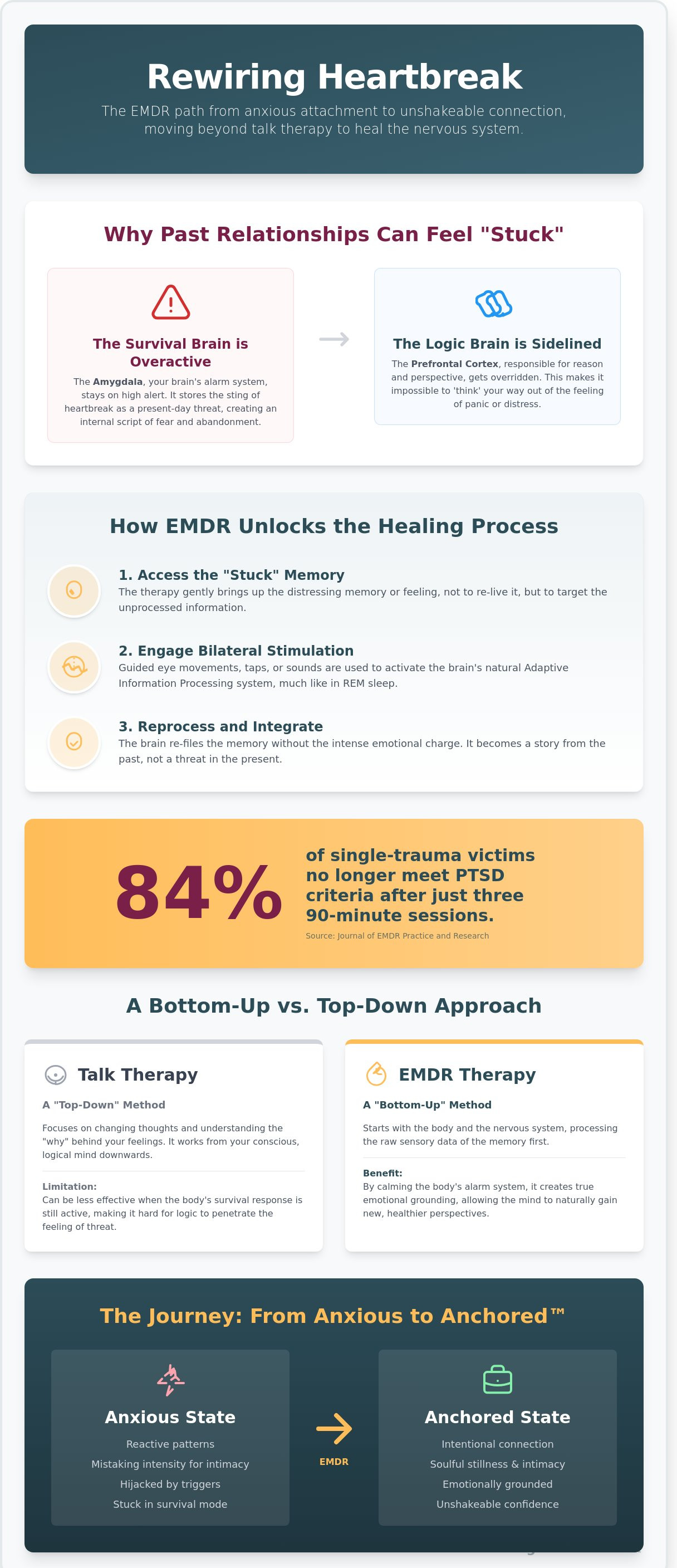
Imagine sitting in a quiet room in London, the weight of a three year relationship pressing against your chest like a physical stone, even though the final goodbye happened months ago. You've talked through the "why" until your voice is thin, yet your body still reacts to a ghost of a text or a familiar scent with a frantic, hijacked pulse. It's here, in the silent gap between understanding and feeling, that emdr offers a different kind of legacy. This isn't just another clinical process; it's a way to reimagine how your nervous system stores the stories of your past. Research published in the Journal of EMDR Practice and Research indicates that 84% of single-trauma victims no longer meet PTSD criteria after just three 90-minute sessions, suggesting a profound shift is possible even when talk therapy feels stagnant.
You likely believe that time heals all wounds, or that if you just analyse the red flags enough, you'll finally feel safe. But as I explore in my book, Overcome Anxious Attachment, your experience is created internally, and often the internal script is simply stuck on a loop of old heartbreak. This article reveals how to move beyond the exhaustion of ruminating and into a state of emotional grounding. We'll explore how to make your thinking visible and use the From Anxious to Anchored™ approach to transition from reactive patterns into a life of unshakeable, secure connection.
Key Takeaways
- Understand how emdr transcends clinical labels to rewire the nervous system, mimicking the rhythmic processing of REM sleep to reprocess stored heartbreak and internal scripts.
- Discover why traditional talk therapy often falls short when the body remains in survival mode, and how a "bottom-up" approach fosters true emotional grounding.
- Recognise the "Oh… this is me" moments in your relationship history by learning to distinguish between chaotic intensity and the soulful stillness of genuine intimacy.
- Learn how to integrate these core shifts into your journey, moving from reactive patterns toward the unshakeable confidence of being From Anxious to Anchored™.
- Gain clarity on how to support your nervous system post-session, transforming your healing into a lasting legacy of authentic, intentional connection.
What is EMDR? A Soulful Introduction to Eye Movement Desensitisation and Reprocessing
The human heart doesn't always speak in linear sentences. Sometimes, it communicates through the sudden, sharp tightening of your chest when a specific song plays, or the frantic, hollow urge to check a phone that has stayed silent for weeks. Eye Movement Desensitization and Reprocessing (EMDR) is a bridge between the clinical and the soulful. It's a rhythmic, neuroscience-informed path to emotional freedom that allows us to move through the static of the past. It began in 1987 when Francine Shapiro noticed that rhythmic eye movements could dampen the distress of disturbing thoughts. Today, it stands as a gold-standard intervention, recognised by the UK’s National Institute for Health and Care Excellence (NICE) as a primary treatment for trauma.
In the context of love and loss, emdr helps us distinguish between intensity and intimacy. We often mistake the high-octane anxiety of a volatile relationship for deep connection. This intensity is usually just the nervous system stuck in a loop. By using bilateral stimulation, such as guided eye movements or taps, this therapy helps the brain process these "stuck" moments. It transforms a jagged, visceral memory into a quiet story that no longer has the power to hijack your present. It's about reclaiming your legacy from the grip of old ghosts.
The Core Philosophy: Healing from the Inside Out
Suffering is rarely about what happened; it's about the meaning we've etched into our souls. As I explore in my book, Overcome Anxious Attachment, experience is created internally. EMDR assists in making thinking visible, slowing down the brain’s reactive processing so you can observe your internal script. We move beyond merely managing triggers. We aim for fundamental core shifts where you realise that fear isn’t truth. It's the difference between watching a film of a storm and being caught in the rain.
Who is it for? Beyond the PTSD Label
We often reserve the word trauma for the battlefield, yet the end of a ten-year marriage or a sudden, unfiltered heartbreak can leave the same neurological footprint. Anxious attachment patterns are often stored as unprocessed sensory memories, keeping you in a state of high alert. Through the From Anxious to Anchored™ programme, we see how emdr helps recover from the emotional pain that follows a breakup. It allows you to move from a reactive state to one of intentional, calm living. If you’re ready to see how your internal script is shaping your reality, start by taking the Emotional Grounding quiz to assess your current path to connection.
The Neuroscience of Healing: How EMDR Rewires Your Internal Script
The mind is a relentless archivist. It stores the sting of a cold shoulder or the silence of an unreturned text as a survival threat, filing these moments away in the amygdala, the brain’s primitive alarm system. When attachment trauma remains unprocessed, this alarm never quite turns off. It creates an internal script where every minor fluctuation in a partner's mood feels like an impending abandonment. The prefrontal cortex, which should offer logic and perspective, becomes sidelined by this high-alert state. We find ourselves reacting to the past while standing in the present.
Through emdr, we begin the delicate work of making thinking visible. This therapy operates on the principle of Adaptive Information Processing, which suggests that the mind has an innate capacity to heal if the blockages are cleared. It allows us to realise that fear isn’t truth. It’s simply an echo. By engaging the brain's natural processing power, we can separate the intensity of a memory from the reality of our current connection. As noted by the American Psychological Association on EMDR, this structured approach helps the brain re-categorise traumatic events so they no longer carry a visceral, disruptive charge.
The Mechanism of Bilateral Stimulation
The heart of emdr lies in bilateral stimulation (BLS). Whether through side-to-side eye movements or rhythmic tactile taps, this process mimics the natural cognitive processing that occurs during REM sleep. It creates a bridge between the left and right hemispheres of the brain. This rhythmic movement reduces the vividness of intrusive relationship memories. It creates a secure base within the neural pathways. The once-jagged edges of a painful memory begin to soften, losing their power to trigger a physiological spiral. We aren't erasing the story; we are simply changing how the body tells it.
Reprocessing the Anxious Attachment Narrative
Most of our relationship struggles stem from an internal script that whispers, "I am not enough," or "They will eventually leave." These aren't facts, yet we feel them with the weight of absolute certainty. In her book, Overcome Anxious Attachment, Kay Tear explores how the mind heals when we stop managing triggers and start addressing the internal landscape. The goal is a core shift from being Anxious to Anchored™. We move away from the performance of love and toward the quiet confidence of being. This isn't about finding external red flags. It’s about cultivating emotional grounding that remains steady regardless of another person's actions. To understand where your own internal script currently sits, you might find clarity by taking this Emotional Grounding assessment.
Why Talk Therapy Isn’t Always Enough: EMDR vs Traditional Approaches
Traditional talk therapy often operates as an intellectual exercise. It relies on a "top-down" approach, where we use logic and conversation to dissect our history. While understanding why you feel anxious is a cognitive triumph, it rarely stops your heart from racing when a partner pulls away. You cannot think your way out of a dysregulated nervous system. Your internal script is written in the language of the body, not just the mind. This is where emdr provides a vital "bottom-up" solution, addressing the physiological echoes of attachment trauma that words alone cannot reach.
According to the National Center for PTSD on EMDR, this approach focuses directly on the memory to change how it is stored in the brain, effectively reducing the vividness and emotional charge of past events. Instead of just managing triggers, we are rewriting the experience from the inside out. It is the difference between knowing your patterns and actually feeling them shift into something calmer and more intentional.
Breaking the Cycle of Rumination
Reliving the past through "talking it through" can sometimes keep us trapped in a cinematic loop of heartbreak. Every time we recount the story, we reinforce the neural pathways of the pain. EMDR helps you stop the spiral of overthinking by desensitising the sting of seeing an ex or facing a dating rejection. It allows the brain to file these moments away as "past," so they no longer bleed into your present reality. By making thinking visible through this process, we stop being victims of our own minds and begin to reclaim our sense of self.
The Speed of Transformation
While traditional psychodynamic work can span years, emdr is frequently described as an accelerated form of emotional processing. Studies have shown that 84% to 90% of single-trauma victims no longer have PTSD after only three 90-minute sessions. It bypasses the need for endless storytelling, moving straight to the core of the emotional blockage. In my book, Overcome Anxious Attachment, I explore how we must distinguish intensity from intimacy. EMDR facilitates this clarity with remarkable speed.
Before deep reprocessing begins, we focus on emotional grounding. This is a foundational element of the From Anxious to Anchored™ programme. It ensures you have the stability to face the shadows without being consumed by them. Choosing between coaching and clinical therapy depends on your current state. If you are experiencing acute clinical symptoms, a therapist is essential. However, if you are ready to bridge the gap between "healing" and "living," an inside-out coaching approach provides the tools to build a legacy of secure, authentic connection.
Identifying Your Patterns: Is EMDR the Key to Breaking Anxious Attachment?
It often begins with a quiet, devastating realisation during a midnight scroll or a tense, silent dinner. You recognise the pattern. The tight chest, the racing heart, and the frantic urge to check your phone are not signs of "spark," but echoes of an internal script written long ago. In my book, Overcome Anxious Attachment, I explore how we frequently mistake high-octane intensity for genuine intimacy. This is the intensity trap. It's a cycle where the chaotic friction of an anxious-avoidant dynamic feels like passion, yet it is actually your nervous system responding to a perceived threat to your safety.
Using emdr allows us to look at the internal script writing these scenes. It isn't about managing triggers; it's about making thinking visible. When you process the memories that fuel your current anxiety, those "Oh… this is me" moments transform from sources of shame into catalysts for a core shift. You move from a reactive state to a place of intentional, calm living. Research published in the Journal of EMDR Practice and Research (2017) indicated that 84% to 90% of single-trauma victims no longer had PTSD after only three 90-minute sessions, proving the profound efficiency of this approach in clearing emotional blockages.
The 8 Phases of EMDR Treatment
The journey through emdr is a structured, soulful descent into your own narrative. It begins with history taking and moves quickly into the "Preparation" phase. This stage is vital for building self-connection; it ensures you have the emotional grounding required to face the shadows. We identify "targets," which are the specific, unfiltered memories that act as the blueprint for your current relationship anxiety. From desensitisation to the final re-evaluation, each phase is designed to dismantle the power that past pain holds over your present peace.
Finding Your Secure Anchor
Healing isn't just the absence of anxiety; it's the presence of Self-Leadership. Through the From Anxious to Anchored™ programme, we use the shifts made during sessions to build a legacy of secure, intentional relationships. You learn to navigate the modern dating landscape with a clear-minded perspective, no longer swayed by the temporary highs of "chemistry" that lack substance. You become the architect of your own connection, choosing partners based on shared values rather than shared wounds. To understand where you currently stand on this journey, I invite you to Take the Attachment Quiz and begin reimagining your path to love.
Ready to stop the cycle of reactive thinking? Discover how to stop the spiral today.
Beyond the Session: Integrating EMDR Insights into Your Journey
The work of healing doesn't end when the bilateral stimulation stops or the session concludes. It's a quiet, unfolding process. After an emdr session, your nervous system exists in a state of recalibration, moving from the high-alert static of trauma into a clearer frequency. This period requires intentional grace. Support this transition through deep hydration and restorative rest; allow yourself the luxury of quiet observation without the pressure to immediately "figure it out." You're not just processing data. You're rewriting the internal script that has dictated your reactions for years.
A vital core shift in this journey is learning to distinguish between a "trigger" and a "red flag." In the past, these might have felt identical: a tightening in the chest or a sudden urge to flee. Through the lens of the From Anxious to Anchored™ framework, we recognise that a trigger is an internal echo of the past, while a red flag is an external observation of the present. Understanding this difference prevents you from over-pathologising your intuition or, conversely, ignoring your boundaries. It's the difference between reacting to a ghost and responding to a reality.
Building Unshakeable Confidence
When your nervous system is regulated, you show up in the "dating centre" with an entirely different energy. You no longer enter spaces seeking external validation to quiet your anxiety. Instead, you operate from a place of internal emotional self-leadership. This is the "unshakeable confidence" detailed in Kay Tear’s book, Overcome Anxious Attachment. It's the profound realization that your experience is created from the inside out. You aren't at the mercy of a partner’s text message or a lukewarm first date; your "anchored" state comes from the quiet strength of knowing your own worth is non-negotiable. Love ceases to be a source of fear and begins to feel like a place of calm, filtered through authenticity rather than performance.
Your Next Steps to Freedom
If you're ready to move from the exhausting spiral of anxious attachment into a legacy of secure connection, the path forward is clear and supported. To find an accredited emdr practitioner in the UK, consult the EMDR Association UK, which ensures clinicians meet rigorous standards of training and ethics. For a truly holistic transformation, many choose to combine clinical emdr with the Love Reimagined Method™. This approach bridges the gap between processing past pain and building a future of intentional intimacy.
- Assess your starting point: Take the Relationship Grounding Quiz to identify your current patterns in boundaries and self-connection.
- Deepen your understanding: Read the foundational principles of emotional grounding in Kay Tear’s signature book.
- Commit to the shift: Explore private coaching or join the From Anxious to Anchored™ signature programme to begin your journey toward unshakeable confidence.
You deserve a love that feels like a sanctuary, not a battlefield. It's time to stop the spiral and start reimagining what’s possible.
Rewriting the Legacy of Your Heart
The journey from anxious attachment to a state of emotional grounding is rarely found in the repetition of old stories. While traditional talk therapy offers a map, emdr provides the compass for a deeper, neuroscience-informed shift. By addressing the internal script where trauma lives, you move beyond merely managing triggers to a place of genuine, unfiltered connection. This isn't about fixing what's broken; it's about reimagining how you hold your own history. As I discuss in my book, Overcome Anxious Attachment, your experience is created from the inside out. When you change the way your mind processes the past, you change the way you feel the present.
Through my ICF-accredited coaching and the From Anxious to Anchored™ programme, I've helped many individuals move from the intensity of fear to the intimacy of secure love. You deserve a relationship that feels like a sanctuary, not a performance. If you're ready to stop the cycle of reactive patterns and start documenting a new story of confidence, taking the first step is vital. Discover your path to secure love with our Relationship Quiz. Your future self is waiting for this core shift. Trust the process; the path to your most authentic connection is already within you.
Frequently Asked Questions
Is EMDR therapy suitable for everyone dealing with heartbreak?
EMDR is a powerful tool for most individuals navigating the wreckage of a lost love, yet its effectiveness relies on your readiness to look inward. It's particularly potent for those whose heartbreak has triggered deep-seated attachment wounds. In the UK, approximately 25% of people experience a mental health problem each year, often exacerbated by relational trauma. While EMDR helps process the intensity of the loss, it works best when paired with an understanding that your experience is created internally through your thinking.
How many sessions of EMDR are typically needed to see a core shift?
Most people begin to notice a core shift within 6 to 12 sessions, though the exact number depends on the complexity of your internal script. This isn't a quick fix but a deliberate reimagining of your past. Research published in the Journal of EMDR Practice and Research in 2014 suggests that 84% to 90% of single-trauma victims no longer have PTSD after only three 90-minute sessions. For attachment trauma, the process is often longer to ensure lasting emotional grounding and secure connection.
Can EMDR be done online, or does it have to be in person?
You can absolutely engage in emdr therapy through online sessions, as modern technology allows for effective bilateral stimulation via screens. This flexibility is vital for those who feel anxious in traditional clinical settings. A 2022 study in the journal Frontiers in Psychology confirmed that remote treatment is just as effective as in-person sessions for reducing distress. It allows you to transform your relationship patterns from the comfort of your own home, making the path to becoming Anchored more accessible.
What is the difference between EMDR and hypnosis?
The primary difference lies in your state of consciousness; emdr requires you to stay fully present and alert while focusing on specific memories. Unlike hypnosis, which often involves a trance-like state to access the subconscious, this method uses bilateral stimulation to help the brain reprocess information naturally. It's about making thinking visible and shifting the meaning of past events. You remain in the driver's seat, intentionally documenting the feelings that arise without losing your sense of current reality or control.
Will EMDR make me forget my past relationships entirely?
EMDR won't erase the memories of your past relationships, but it will strip away the painful emotional charge that keeps you stuck. Think of it as preserving the legacy of the experience while removing the sting of the trauma. You'll remember what happened, but the intensity will no longer be mistaken for intimacy. As discussed in the book Overcome Anxious Attachment, the goal is to stop the past from dictating your present internal script, allowing for a clear-minded and intentional future.
Is EMDR safe for people with high levels of relationship anxiety?
It's safe and often transformative for those with high relationship anxiety, provided you work with a specialist who prioritises emotional grounding. The process helps you realise that fear isn't truth, even when it feels overwhelming. By addressing the root of your anxious attachment, the therapy allows you to move toward a more secure connection. It’s a vital component of the From Anxious to Anchored™ journey, helping you navigate the ebb and flow of dating with unshakeable confidence.
How do I know if my attachment issues are "trauma" enough for EMDR?
There's no trauma threshold you must meet; if your attachment patterns cause persistent suffering, they're significant enough for EMDR. Trauma is often found in the quiet, unseen moments of childhood neglect or repeated rejection rather than just single, catastrophic events. If you find yourself repeatedly trapped in reactive patterns, your internal script is calling for attention. This isn't about comparing scars; it's about acknowledging that your current experience of love is being filtered through past pain.
Can I use EMDR techniques on myself at home?
You shouldn't attempt EMDR techniques on yourself at home because the process can surface intense emotions that require professional containment. While you can practice self-soothing and emotional grounding, the actual reprocessing needs a trained guide to ensure safety. Attempting to DIY this deep psychological work can lead to flooding or further distress. Instead, focus on understanding the inside-out nature of your feelings and consider taking our quiz to assess your current level of self-connection and relationship closure.